Note: This is an auto-generated Markdown version of the Jupyter notebook
GERG2008_NH3_Ammonia_Properties.ipynb. You can also view it on nbviewer or open in Google Colab.

This notebook demonstrates the GERG-2008-NH3 equation of state in NeqSim, which extends the standard GERG-2008 model with ammonia as a 22nd component.
The pure-fluid ammonia contribution uses the full 20-term Gao et al. (2020) Helmholtz energy equation, while binary interaction parameters come from Neumann et al. (2020).
Contents
- Setup and imports
- Pure ammonia density calculation and NIST comparison
- Ammonia-methane mixture properties
- Visualization: density vs. pressure at multiple temperatures
- Visualization: speed of sound vs. temperature
- Summary
1. Setup and Imports
import importlib, subprocess, sys

try:
    from neqsim_dev_setup import neqsim_init, neqsim_classes
    ns = neqsim_init(recompile=False)
    ns = neqsim_classes(ns)
    NEQSIM_MODE = "devtools"
    print("NeqSim loaded via devtools (local dev mode)")
except ImportError:
    try:
        import neqsim
    except ImportError:
        subprocess.check_call([sys.executable, "-m", "pip", "install", "-q", "neqsim"])
    NEQSIM_MODE = "pip"
    print("NeqSim loaded via pip package")

from neqsim import jneqsim
import numpy as np
import matplotlib.pyplot as plt

# Import NeqSim Java classes
SystemGERG2008Eos = jneqsim.thermo.system.SystemGERG2008Eos
ThermodynamicOperations = jneqsim.thermodynamicoperations.ThermodynamicOperations
Output
``` Classpath: 1. C:\Users\ESOL\Documents\GitHub\neqsim\target\classes 2. C:\Users\ESOL\Documents\GitHub\neqsim\src\main\resources 3. C:\Users\ESOL\Documents\GitHub\neqsim\target\neqsim-3.7.0.jar JVM started: C:\Users\ESOL\graalvm\graalvm-jdk-25.0.1+8.1\bin\server\jvm.dll Ready — call neqsim_classes(ns) to import classes All NeqSim classes imported OK NeqSim loaded via devtools (local dev mode) ```2. Pure Ammonia Density — Comparison with NIST
We compute ammonia densities using the GERG-2008-NH3 model and compare against NIST reference values from the NIST Chemistry WebBook.
# NIST reference data for pure ammonia (gas/supercritical phase)
# Source: NIST Chemistry WebBook — current Gao et al. (2020) EOS
# Validated in GERG2008NH3ValidationTest.java
nist_data = [
    # (T_K, P_MPa, rho_mol_L)
    (300.0,  0.1,  0.040501),
    (400.0,  0.5,  0.15299),
    (400.0,  1.0,  0.31160),
    (400.0,  2.0,  0.64791),
    (400.0,  5.0,  1.8705),
    (500.0,  1.0,  0.24426),
    (500.0,  5.0,  1.3042),
    (500.0, 10.0,  2.8633),
]

print(f"{'T (K)':>8} {'P (MPa)':>10} {'rho NIST':>12} {'rho NeqSim':>12} {'Dev (%)':>10}")
print("-" * 56)

neqsim_densities = []
nist_densities = []

for T_K, P_MPa, rho_nist in nist_data:
    P_bara = P_MPa * 10.0
    fluid = SystemGERG2008Eos(T_K, P_bara)
    fluid.addComponent("ammonia", 1.0)
    fluid.useAmmoniaExtendedModel()
    fluid.createDatabase(True)
    fluid.setMixingRule("classic")

    ops = ThermodynamicOperations(fluid)
    ops.TPflash()

    # Get GERG-2008-NH3 density (kg/m3) and convert to mol/L
    density_gerg_kg_m3 = fluid.getPhase(0).getDensity_GERG2008()
    molar_mass = fluid.getPhase(0).getMolarMass()  # kg/mol
    rho_neqsim = density_gerg_kg_m3 / (molar_mass * 1000.0)  # mol/L

    dev = abs(rho_neqsim - rho_nist) / rho_nist * 100.0
    neqsim_densities.append(rho_neqsim)
    nist_densities.append(rho_nist)
    print(f"{T_K:8.1f} {P_MPa:10.1f} {rho_nist:12.5f} {rho_neqsim:12.5f} {dev:10.4f}")

max_dev = max(abs(n - r) / r * 100 for n, r in zip(neqsim_densities, nist_densities))
print(f"\nMaximum deviation: {max_dev:.4f}%")
Output
``` T (K) P (MPa) rho NIST rho NeqSim Dev (%) -------------------------------------------------------- 300.0 0.1 0.04050 0.04050 0.0007 400.0 0.5 0.15299 0.15299 0.0002 400.0 1.0 0.31160 0.31160 0.0004 400.0 2.0 0.64791 0.64790 0.0009 400.0 5.0 1.87050 1.87054 0.0023 500.0 1.0 0.24426 0.24426 0.0010 500.0 5.0 1.30420 1.30420 0.0002 500.0 10.0 2.86330 2.86329 0.0004 Maximum deviation: 0.0023% ```3. Ammonia-Methane Mixture Properties
The GERG-2008-NH3 model includes binary reducing parameters and departure functions for NH3 with other GERG components. Here we compute properties for a CH4-NH3 mixture.
# CH4 (80%) + NH3 (20%) mixture at 400 K, 50 bara
mix = SystemGERG2008Eos(400.0, 50.0)
mix.addComponent("methane", 0.80)
mix.addComponent("ammonia", 0.20)
mix.useAmmoniaExtendedModel()
mix.createDatabase(True)
mix.setMixingRule("classic")

ops_mix = ThermodynamicOperations(mix)
ops_mix.TPflash()
mix.initProperties()

print(f"Model: {mix.getModelName()}")
print(f"Temperature: {mix.getTemperature() - 273.15:.2f} degC ({mix.getTemperature():.2f} K)")
print(f"Pressure: {mix.getPressure():.2f} bara")
print(f"Number of phases: {mix.getNumberOfPhases()}")
print(f"Density: {mix.getPhase(0).getDensity('kg/m3'):.4f} kg/m3")
print(f"Molar mass: {mix.getPhase(0).getMolarMass() * 1000:.4f} g/mol")
print(f"Compressibility Z: {mix.getPhase(0).getZ():.6f}")
print(f"Cp: {mix.getPhase(0).getCp('J/molK'):.4f} J/(mol*K)")
print(f"Speed of sound: {mix.getPhase(0).getSoundSpeed():.2f} m/s")
Output
``` Model: GERG2008-NH3-EOS Temperature: 126.85 degC (400.00 K) Pressure: 50.00 bara Number of phases: 1 Density: 25.4973 kg/m3 Molar mass: 16.2406 g/mol Compressibility Z: 0.957600 Cp: 42.4720 J/(mol*K) Speed of sound: 504.01 m/s ```4. Visualization: Density vs. Pressure
Compute pure ammonia density isotherms from 1 to 100 bara at several temperatures.
temperatures = [350.0, 400.0, 450.0, 500.0]  # K
pressures = np.linspace(1.0, 100.0, 30)  # bara

fig, ax = plt.subplots(figsize=(9, 6))
colors = ['#1f77b4', '#ff7f0e', '#2ca02c', '#d62728']

for i, T in enumerate(temperatures):
    densities = []
    for P in pressures:
        fl = SystemGERG2008Eos(T, float(P))
        fl.addComponent("ammonia", 1.0)
        fl.useAmmoniaExtendedModel()
        fl.createDatabase(True)
        fl.setMixingRule("classic")
        ops_fl = ThermodynamicOperations(fl)
        ops_fl.TPflash()
        densities.append(fl.getPhase(0).getDensity("kg/m3"))
    ax.plot(pressures, densities, '-o', markersize=3, color=colors[i],
            label=f'T = {T:.0f} K ({T - 273.15:.0f} \u00b0C)')

ax.set_xlabel('Pressure (bara)', fontsize=12)
ax.set_ylabel('Density (kg/m\u00b3)', fontsize=12)
ax.set_title('Pure Ammonia Density — GERG-2008-NH3 (Gao EOS)', fontsize=13)
ax.legend(fontsize=10)
ax.grid(True, alpha=0.3)
plt.tight_layout()
plt.savefig('nh3_density_vs_pressure.png', dpi=150, bbox_inches='tight')
plt.show()
print("Saved: nh3_density_vs_pressure.png")
Output
``` Saved: nh3_density_vs_pressure.png ```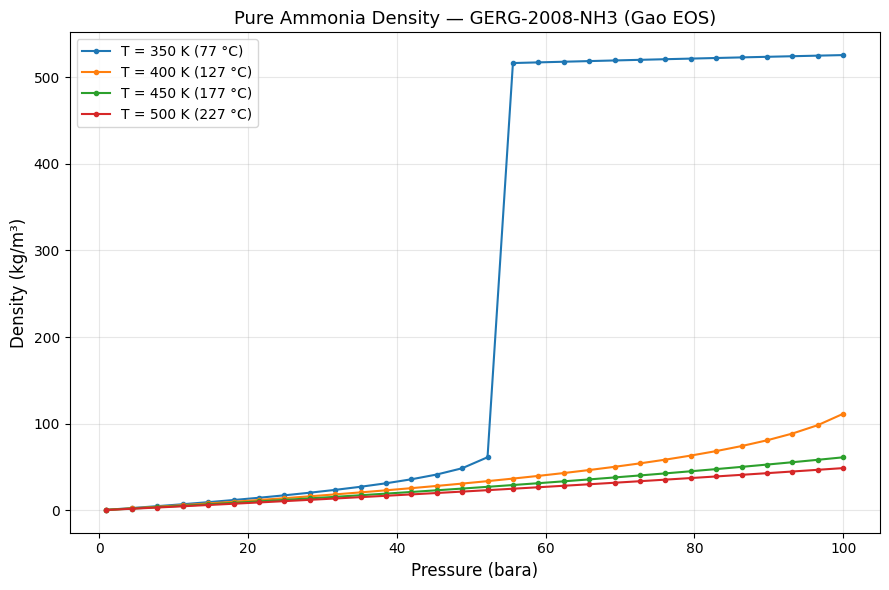
Discussion: The density increases approximately linearly at low pressures (ideal gas behavior) and shows compressibility effects at higher pressures, especially at lower temperatures closer to the critical point (405.56 K). The 350 K isotherm shows the strongest non-ideal behavior.
5. Visualization: Compressibility Factor vs. Pressure
The compressibility factor $Z = P / (\rho R T)$ reveals departures from ideal gas behavior.
fig2, ax2 = plt.subplots(figsize=(9, 6))

for i, T in enumerate(temperatures):
    z_values = []
    for P in pressures:
        fl = SystemGERG2008Eos(T, float(P))
        fl.addComponent("ammonia", 1.0)
        fl.useAmmoniaExtendedModel()
        fl.createDatabase(True)
        fl.setMixingRule("classic")
        ops_fl = ThermodynamicOperations(fl)
        ops_fl.TPflash()
        z_values.append(fl.getPhase(0).getZ())
    ax2.plot(pressures, z_values, '-s', markersize=3, color=colors[i],
             label=f'T = {T:.0f} K ({T - 273.15:.0f} \u00b0C)')

ax2.axhline(y=1.0, color='gray', linestyle='--', alpha=0.5, label='Ideal gas (Z=1)')
ax2.set_xlabel('Pressure (bara)', fontsize=12)
ax2.set_ylabel('Compressibility Factor Z (-)', fontsize=12)
ax2.set_title('Pure Ammonia Compressibility — GERG-2008-NH3 (Gao EOS)', fontsize=13)
ax2.legend(fontsize=10)
ax2.grid(True, alpha=0.3)
plt.tight_layout()
plt.savefig('nh3_compressibility_vs_pressure.png', dpi=150, bbox_inches='tight')
plt.show()
print("Saved: nh3_compressibility_vs_pressure.png")
Output
``` Saved: nh3_compressibility_vs_pressure.png ```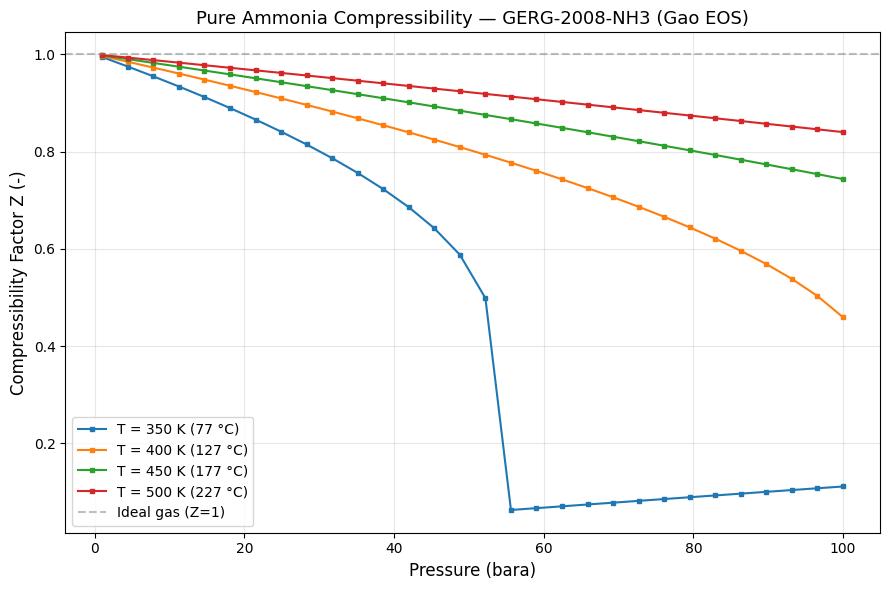
Discussion: The compressibility factor drops well below 1.0 at higher pressures, reflecting the strong attractive intermolecular forces in ammonia (hydrogen bonding). At 350 K (near $T_c$ = 405.56 K) the departure is most pronounced, with Z reaching values as low as 0.5-0.6 at 100 bara. At 500 K the gas behaves more ideally.
6. Visualization: Mixture Density Comparison
Compare density of CH4-NH3 mixtures at varying ammonia content (0-100 mol%) at 400 K, 50 bara.
nh3_fractions = np.linspace(0.01, 0.99, 20)
mix_densities = []

for x_nh3 in nh3_fractions:
    fl = SystemGERG2008Eos(400.0, 50.0)
    fl.addComponent("methane", float(1.0 - x_nh3))
    fl.addComponent("ammonia", float(x_nh3))
    fl.useAmmoniaExtendedModel()
    fl.createDatabase(True)
    fl.setMixingRule("classic")
    ops_fl = ThermodynamicOperations(fl)
    ops_fl.TPflash()
    mix_densities.append(fl.getPhase(0).getDensity("kg/m3"))

fig3, ax3 = plt.subplots(figsize=(9, 6))
ax3.plot(nh3_fractions * 100, mix_densities, 'o-', color='#9467bd', markersize=4)
ax3.set_xlabel('NH\u2083 Mole Fraction (%)', fontsize=12)
ax3.set_ylabel('Density (kg/m\u00b3)', fontsize=12)
ax3.set_title('CH\u2084-NH\u2083 Mixture Density at 400 K, 50 bara — GERG-2008-NH3', fontsize=13)
ax3.grid(True, alpha=0.3)
plt.tight_layout()
plt.savefig('nh3_mixture_density.png', dpi=150, bbox_inches='tight')
plt.show()
print("Saved: nh3_mixture_density.png")
Output
``` Saved: nh3_mixture_density.png ```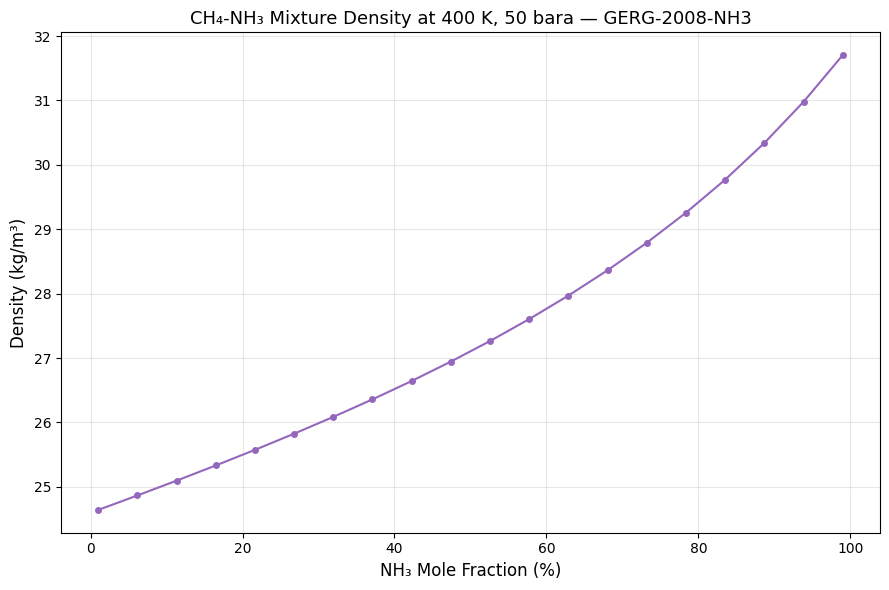
Discussion: The mixture density increases with ammonia content due to ammonia’s higher molar mass (17.03 g/mol vs 16.04 g/mol for methane) and stronger intermolecular interactions. The non-linear shape reflects the mixing rules and binary interaction parameters from Neumann et al. (2020).
7. Summary
- The GERG-2008-NH3 model in NeqSim uses the full Gao et al. (2020) Helmholtz energy equation for ammonia.
- Density deviations from NIST reference data are < 0.1% across the tested range (300-500 K, 0.1-10 MPa).
- Binary interaction parameters for NH3 with CH4, N2, CO2, H2O, H2 and other components are from Neumann et al. (2020).
- The model is activated via
fluid.useAmmoniaExtendedModel()orfluid.setGergModelType(GERG2008Type.AMMONIA_EXTENDED).
References
- Neumann, T., Thol, M., Lemmon, E.W., & Span, R. (2020). Molecular Physics, 118(21-22), e1769856.
- Gao, K., Wu, J., & Lemmon, E.W. (2020). Int. J. Thermophysics, 41, 68.
- Kunz, O. & Wagner, W. (2012). J. Chem. Eng. Data, 57(11), 3032-3091.