Note: This is an auto-generated Markdown version of the Jupyter notebook
ReadingFluidProperties.ipynb. You can also view it on nbviewer or open in Google Colab.
Reading Fluid Properties in NeqSim
This executable notebook shows how to read thermodynamic, transport, phase, component, and interfacial properties through the public NeqSim Python gateway. Values are model results for one illustrative SRK fluid; they are not reference data or design guarantees.
The examples keep units explicit and include numerical consistency checks.
Constructors use kelvin and bar absolute (bara) unless an overload explicitly
accepts a unit.
# Public-PyPI-compatible setup for a clean Google Colab runtime.
import importlib.util
import subprocess
import sys

if importlib.util.find_spec("neqsim") is None:
    subprocess.check_call(
        [sys.executable, "-m", "pip", "install", "--quiet", "neqsim"]
    )

import importlib.metadata
import json

import matplotlib.pyplot as plt
import pandas as pd
from neqsim import jneqsim

SystemSrkEos = jneqsim.thermo.system.SystemSrkEos
ThermodynamicOperations = jneqsim.thermodynamicoperations.ThermodynamicOperations

print(f"NeqSim: {importlib.metadata.version('neqsim')}")
print(f"Python: {sys.version.split()[0]}")
Output
``` NeqSim: 3.17.0 Python: 3.12.13 ```Create and flash a two-phase fluid
addComponent(name, amount) adds moles. Because these amounts sum to one mole,
they are also the overall mole fractions for this example. A TP flash establishes
the equilibrium phase count and compositions before properties are read.
fluid = SystemSrkEos(298.15, 50.0)
component_amounts = {
    "nitrogen": 0.02,
    "CO2": 0.03,
    "methane": 0.70,
    "ethane": 0.10,
    "propane": 0.08,
    "n-butane": 0.04,
    "n-pentane": 0.02,
    "n-hexane": 0.01,
}

for component_name, amount_mol in component_amounts.items():
    fluid.addComponent(component_name, amount_mol)

fluid.setMixingRule("classic")
ThermodynamicOperations(fluid).TPflash()
fluid.initProperties()

assert fluid.getNumberOfPhases() == 2
assert fluid.hasPhaseType("gas")
assert fluid.hasPhaseType("oil")

print(f"Phases: {fluid.getNumberOfPhases()}")
print(f"Temperature: {fluid.getTemperature('C'):.2f} °C")
print(f"Pressure: {fluid.getPressure('bara'):.2f} bara")
Output
``` Phases: 2 Temperature: 25.00 °C Pressure: 50.00 bara ```Initialization levels
| Call | Main result made available |
|---|---|
init(0) |
Composition bookkeeping |
init(1) |
Fugacity coefficients, compressibility, and equation-of-state volume |
init(2) |
Enthalpy, entropy, heat capacities, and related thermodynamic properties |
init(3) |
Composition derivatives used by advanced algorithms |
initPhysicalProperties() |
Transport properties and corrected-density property models |
initProperties() |
Convenience call for init(2) plus physical properties |
initProperties() is appropriate for this reporting example. It does not imply
that every optional specialized model, derivative, or phase-specific correlation
has been validated for every fluid.
Overall and phase properties
Overall extensive properties depend on the amount of fluid in the object. The table below therefore uses explicit molar or mass-specific units where possible.
overall_properties = pd.DataFrame(
    [
        ("Molar mass", fluid.getMolarMass("gr/mol"), "g/mol"),
        ("Molar enthalpy", fluid.getEnthalpy("J/mol"), "J/mol"),
        ("Molar entropy", fluid.getEntropy("J/molK"), "J/(mol·K)"),
        ("Mass-specific Cp", fluid.getCp("kJ/kgK"), "kJ/(kg·K)"),
        ("Mass-specific Cv", fluid.getCv("kJ/kgK"), "kJ/(kg·K)"),
        ("Cp/Cv", fluid.getGamma(), "-"),
    ],
    columns=["Property", "Value", "Unit"],
)

assert overall_properties["Value"].map(lambda value: float(value)).notna().all()
overall_properties
Output
``` Property Value Unit 0 Molar mass 24.275120 g/mol 1 Molar enthalpy -1611.716128 J/mol 2 Molar entropy -26.540090 J/(mol·K) 3 Mass-specific Cp 2.485042 kJ/(kg·K) 4 Mass-specific Cv 1.637272 kJ/(kg·K) 5 Cp/Cv 1.517794 - ```phase_rows = []
for phase_index in range(fluid.getNumberOfPhases()):
phase = fluid.getPhase(phase_index)
phase_rows.append(
{
"Phase": str(phase.getType()),
"Mole fraction": phase.getMoleFraction(),
"Z": phase.getZ(),
"Molar mass [g/mol]": phase.getMolarMass("gr/mol"),
"Density [kg/m³]": phase.getDensity("kg/m3"),
"Viscosity [cP]": phase.getViscosity("cP"),
"Conductivity [W/(m·K)]": phase.getThermalConductivity("W/mK"),
"Sound speed [m/s]": phase.getSoundSpeed(),
}
)
phase_properties = pd.DataFrame(phase_rows)
assert abs(phase_properties["Mole fraction"].sum() - 1.0) < 1.0e-10
assert (phase_properties["Density [kg/m³]"] > 0.0).all()
assert (phase_properties["Viscosity [cP]"] > 0.0).all()
phase_properties
Output
``` Phase Mole fraction ... Conductivity [W/(m·K)] Sound speed [m/s] 0 GAS 0.922517 ... 0.035558 346.675386 1 OIL 0.077483 ... 0.093688 624.541749 [2 rows x 8 columns] ```Equation-of-state and corrected density
The no-argument phase.getDensity() reads the equation-of-state density. The
overload with an explicit unit reads the initialized physical-property density,
which applies the configured volume correction for this SRK fluid. The corrected
result is generally preferable for reporting, but it remains a model prediction
that should be validated against representative density data for engineering use.
density_rows = []
for phase_index in range(fluid.getNumberOfPhases()):
    phase = fluid.getPhase(phase_index)
    eos_density = phase.getDensity()
    corrected_density = phase.getDensity("kg/m3")
    density_rows.append(
        {
            "Phase": str(phase.getType()),
            "EoS density [kg/m³]": eos_density,
            "Corrected density [kg/m³]": corrected_density,
            "Relative change [%]": 100.0
            * (corrected_density - eos_density)
            / eos_density,
        }
    )

density_comparison = pd.DataFrame(density_rows)
assert (density_comparison["Corrected density [kg/m³]"] > 0.0).all()
density_comparison
Output
``` Phase EoS density [kg/m³] Corrected density [kg/m³] Relative change [%] 0 GAS 53.662199 53.870577 0.388315 1 OIL 479.969712 515.117847 7.322990 ```Component material-balance check
getz() is the overall mole fraction and getx() is the mole fraction in one
phase. For each component, the flashed state should satisfy
z_i = Σ_α β_α x_i,α within numerical tolerance.
gas_phase = fluid.getPhase("gas")
oil_phase = fluid.getPhase("oil")
gas_fraction = gas_phase.getMoleFraction()
oil_fraction = oil_phase.getMoleFraction()

composition_rows = []
maximum_balance_error = 0.0
for component_index in range(fluid.getNumberOfComponents()):
    component_name = str(fluid.getComponent(component_index).getComponentName())
    overall_fraction = fluid.getComponent(component_index).getz()
    gas_composition = gas_phase.getComponent(component_index).getx()
    oil_composition = oil_phase.getComponent(component_index).getx()
    reconstructed_fraction = (
        gas_fraction * gas_composition + oil_fraction * oil_composition
    )
    balance_error = abs(reconstructed_fraction - overall_fraction)
    maximum_balance_error = max(maximum_balance_error, balance_error)
    composition_rows.append(
        {
            "Component": component_name,
            "z overall": overall_fraction,
            "y gas": gas_composition,
            "x oil": oil_composition,
            "K = y/x": gas_composition / oil_composition,
            "Balance error": balance_error,
        }
    )

composition_table = pd.DataFrame(composition_rows)
assert maximum_balance_error < 1.0e-10
print(f"Maximum component balance error: {maximum_balance_error:.3e}")
composition_table
Output
``` Maximum component balance error: 3.469e-18 Component z overall y gas x oil K = y/x Balance error 0 nitrogen 0.02 0.021474 0.002454 8.751849 0.000000e+00 1 CO2 0.03 0.031036 0.017666 1.756812 0.000000e+00 2 methane 0.70 0.741289 0.208407 3.556924 0.000000e+00 3 ethane 0.10 0.099369 0.107509 0.924288 0.000000e+00 4 propane 0.08 0.069830 0.201091 0.347253 0.000000e+00 5 n-butane 0.04 0.026506 0.200661 0.132094 0.000000e+00 6 n-pentane 0.02 0.008337 0.158855 0.052485 3.469447e-18 7 n-hexane 0.01 0.002159 0.103357 0.020887 1.734723e-18 ```plot_table = composition_table.set_index("Component")[["y gas", "x oil"]]
axis = plot_table.plot.bar(figsize=(10, 4.8), width=0.8)
axis.set_ylabel("Mole fraction [-]")
axis.set_title("Equilibrium gas and oil compositions at 25 °C and 50 bara")
axis.grid(axis="y", alpha=0.3)
axis.legend(["Gas phase", "Oil phase"])
plt.xticks(rotation=35, ha="right")
plt.tight_layout()
plt.show()
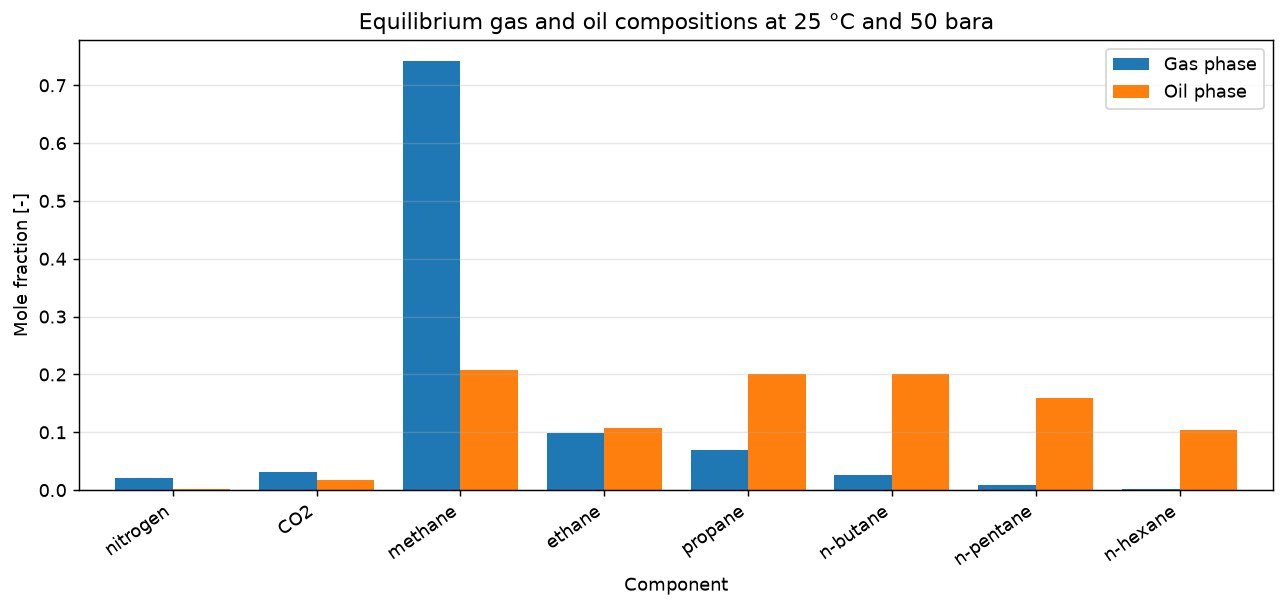
The gas phase is methane-rich, while heavier hydrocarbons are enriched in the oil phase. This is the expected volatility ordering for the stated SRK screening case. The result should not be transferred to custody-transfer or reservoir-fluid work without selecting and validating a thermodynamic model against suitable measurements.
Pure-component constants and explicit unit conversion
For the current component API, getTC() returns kelvin, getPC() returns bar
absolute, and getMolarMass() returns kg/mol. Explicit-unit system getters are
used below; changing the global Units display configuration does not convert
the no-argument system temperature and pressure getters.
constant_rows = []
for component_index in range(fluid.getNumberOfComponents()):
    component = fluid.getComponent(component_index)
    constant_rows.append(
        {
            "Component": str(component.getComponentName()),
            "Tc [K]": component.getTC(),
            "Pc [bara]": component.getPC(),
            "Acentric factor [-]": component.getAcentricFactor(),
            "Molar mass [g/mol]": 1000.0 * component.getMolarMass(),
        }
    )

component_constants = pd.DataFrame(constant_rows)
assert (component_constants["Tc [K]"] > 0.0).all()
assert (component_constants["Pc [bara]"] > 0.0).all()
component_constants
Output
``` Component Tc [K] Pc [bara] Acentric factor [-] Molar mass [g/mol] 0 nitrogen 126.10 33.944 0.0403 28.0135 1 CO2 304.19 73.815 0.2276 44.0100 2 methane 190.56 45.990 0.0115 16.0430 3 ethane 305.32 48.720 0.0995 30.0700 4 propane 369.83 42.480 0.1523 44.0970 5 n-butane 425.12 37.960 0.2002 58.1230 6 n-pentane 469.70 33.700 0.2515 72.1500 7 n-hexane 507.60 30.250 0.3013 86.1770 ```unit_conversions = pd.DataFrame(
[
("Pressure", fluid.getPressure("bara"), "bara"),
("Pressure", fluid.getPressure("Pa"), "Pa"),
("Pressure", fluid.getPressure("psia"), "psia"),
("Temperature", fluid.getTemperature("K"), "K"),
("Temperature", fluid.getTemperature("C"), "°C"),
("Temperature", fluid.getTemperature("F"), "°F"),
("Gas density", gas_phase.getDensity("lb/ft3"), "lb/ft³"),
("Gas viscosity", gas_phase.getViscosity("Pas"), "Pa·s"),
],
columns=["Property", "Value", "Unit"],
)
assert abs(fluid.getPressure("Pa") - 5.0e6) < 1.0e-6
assert abs(fluid.getTemperature("F") - 77.0) < 1.0e-10
unit_conversions
Output
``` Property Value Unit 0 Pressure 5.000000e+01 bara 1 Pressure 5.000000e+06 Pa 2 Pressure 7.251887e+02 psia 3 Temperature 2.981500e+02 K 4 Temperature 2.500000e+01 °C 5 Temperature 7.700000e+01 °F 6 Gas density 3.363030e+00 lb/ft³ 7 Gas viscosity 1.260166e-05 Pa·s ```Interfacial tension and JSON output
Interfacial tension is meaningful only when both requested phases exist and the selected interfacial-property model is applicable. The JSON helpers are useful for reporting, but downstream code should treat their field names and units as an explicit schema contract rather than infer units from a number.
interfacial_tension_n_per_m = fluid.getInterfacialTension("gas", "oil")
assert interfacial_tension_n_per_m > 0.0
print(
    "Gas-oil interfacial tension: "
    f"{1000.0 * interfacial_tension_n_per_m:.4f} mN/m"
)

fluid_json = json.loads(str(fluid.toJson()))
component_json = json.loads(str(fluid.toCompJson()))
assert "properties" in fluid_json
assert "composition" in fluid_json
assert "properties" in component_json
print("Fluid JSON top-level keys:", sorted(fluid_json))
print("Component JSON entries:", len(component_json["properties"]))
Output
``` Gas-oil interfacial tension: 5.4182 mN/m Fluid JSON top-level keys: ['composition', 'conditions', 'name', 'properties'] Component JSON entries: 8 ```Interpretation checklist
- Flash the state before reading phase-dependent properties.
- Call the initialization level required by the property; use
initProperties()for the thermodynamic and transport reporting shown here. - Request units explicitly. No-argument temperature and pressure getters remain kelvin and bara even if a global display-unit set is changed.
- Check phase existence before accessing a named phase.
- Verify component balances and physically plausible phase ordering.
- Treat SRK densities, transport properties, interfacial tension, and phase split as model predictions requiring validation for the intended fluid and range.
Related current interfaces: