Note: This is an auto-generated Markdown version of the Jupyter notebook
ReservoirToMarket_DebottleneckPortfolio.ipynb. You can also view it on nbviewer or open in Google Colab.
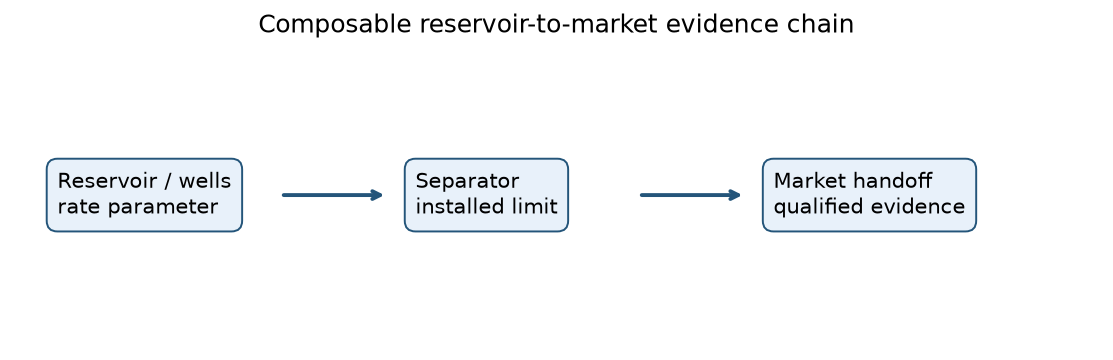
This canonical synthetic workflow turns one reservoir-to-market capacity question into auditable NeqSim evidence:
well throughput -> process simulation -> installed constraint -> paired alternatives -> ranking
The notebook uses the merged ProcessModelDebottleneckStudy and
ProcessModelDebottleneckRanking APIs. It keeps stable area, equipment, constraint, study,
alternative, policy, and metric identities together with explicit units, provenance,
confidence, and diagnostics.
The example is a screening workflow, not a design certificate, causal production-loss claim, shadow price, global optimum, certified emissions inventory, NPV, or investment approval.
1. Engineering question, units, and acceptance gates
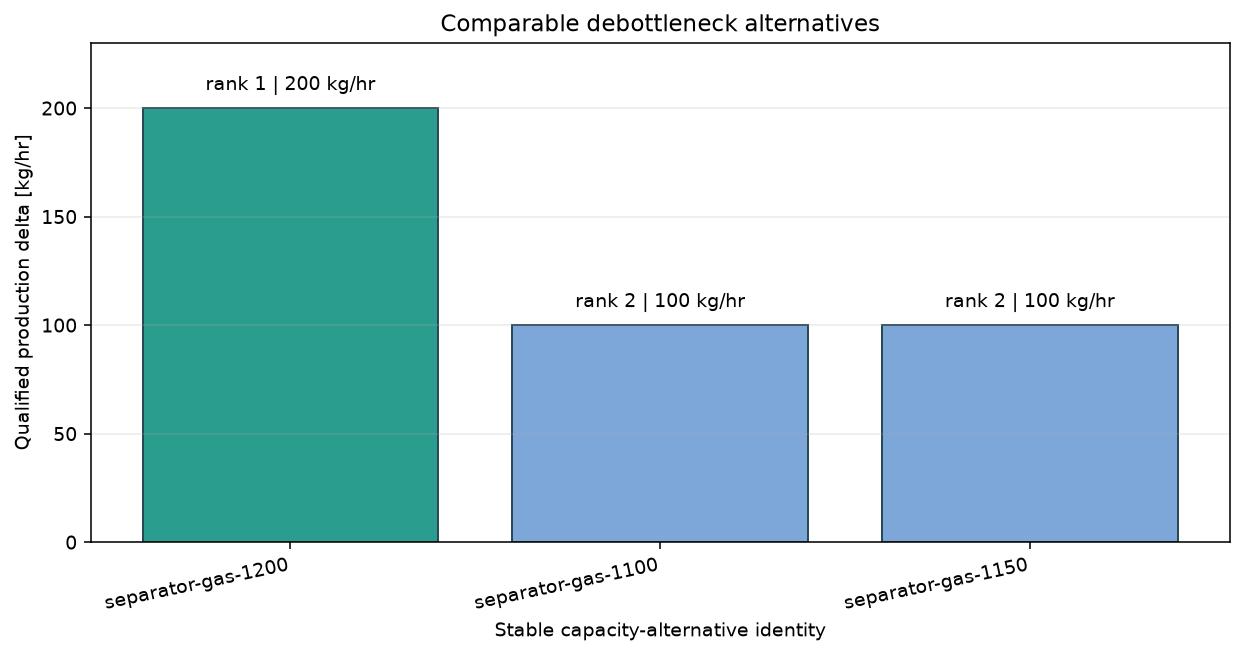
A dry-gas well stream feeds a separator with an installed wet-feed capacity of 1,000 kg/hr. Three replacement alternatives raise the installed limit to 1,100, 1,150, and 1,200 kg/hr. Every alternative uses the same ordered candidate grid and the same maximization objective.
For an upper capacity limit $L$ and simulated rate $q$, the physical margin and normalized residual are:
\[m_c=L-q\] \[r_c=\frac{q-L}{L}\]Feasibility requires $m_c\geq0$. The paired production evidence is:
\[\Delta q=q_{alternative}-q_{baseline}\]Acceptance gates:
- the installed and proposed studies use identical simulator/search metadata;
- all selected rates remain inside declared parameter and equipment bounds;
- the live installed limit and process state are restored after every study;
- repeated execution gives the same rank, identity, and delta;
- serialization retains the immutable evidence;
- incompatible units or insufficient confidence fail closed with explicit diagnostics.
import os
import subprocess
import sys
from pathlib import Path


def find_project_root():
    configured = os.environ.get("NEQSIM_PROJECT_ROOT")
    if configured:
        return Path(configured).resolve()

    current = Path.cwd().resolve()
    for candidate in [current] + list(current.parents):
        if (candidate / "pom.xml").is_file():
            return candidate

    try:
        import google.colab  # noqa: F401
    except ImportError as error:
        raise RuntimeError(
            "Set NEQSIM_PROJECT_ROOT or run this notebook from a NeqSim checkout."
        ) from error

    clone_root = Path("/content/neqsim")
    if not clone_root.exists():
        subprocess.check_call(
            [
                "git",
                "clone",
                "--depth",
                "1",
                "https://github.com/equinor/neqsim.git",
                str(clone_root),
            ]
        )
    return clone_root


PROJECT_ROOT = find_project_root()
sys.path.insert(0, str(PROJECT_ROOT / "devtools"))

from neqsim_dev_setup import neqsim_init


compiled_classes = PROJECT_ROOT / "target" / "classes"
needs_compile = not compiled_classes.is_dir()
ns = neqsim_init(
    project_root=PROJECT_ROOT,
    recompile=needs_compile,
    verbose=False,
)

try:
    source_ref = subprocess.check_output(
        ["git", "rev-parse", "HEAD"],
        cwd=PROJECT_ROOT,
        text=True,
        stderr=subprocess.DEVNULL,
    ).strip()
except (OSError, subprocess.CalledProcessError):
    source_ref = os.environ.get("NEQSIM_SOURCE_REF", "unavailable")

print(f"NeqSim project: {PROJECT_ROOT}")
print(f"Source reference: {source_ref}")
print("Merged debottleneck study and ranking APIs loaded")
Output
``` NeqSim project: /workspace/scratch/62ebdac6e5b4/neqsim-main Source reference: master 1505466864a8e8e7f6838f36192cb8a23bbd3b0d with exact merged dependency-11/12 classes Merged debottleneck study and ranking APIs loaded ```2. Load the exact Java APIs
The notebook uses explicit nested-class names so JPype resolves the same public Java types used by native callers. Python callbacks implement Java functional interfaces only for the synthetic rate supplier, objective, and metric sample.
import math

import jpype
import matplotlib.pyplot as plt
import numpy as np
import pandas as pd
from IPython.display import display


JClass = jpype.JClass
JArray = jpype.JArray
JDouble = jpype.JDouble

SystemSrkEos = JClass("neqsim.thermo.system.SystemSrkEos")
Stream = JClass("neqsim.process.equipment.stream.Stream")
Separator = JClass("neqsim.process.equipment.separator.Separator")
CapacityConstraint = JClass(
    "neqsim.process.equipment.capacity.CapacityConstraint"
)
ConstraintType = JClass(
    "neqsim.process.equipment.capacity.CapacityConstraint$ConstraintType"
)
ConstraintSeverity = JClass(
    "neqsim.process.equipment.capacity.CapacityConstraint$ConstraintSeverity"
)
ProcessSystem = JClass("neqsim.process.processmodel.ProcessSystem")
ProcessModel = JClass("neqsim.process.processmodel.ProcessModel")
Evaluator = JClass(
    "neqsim.process.util.optimizer.ProcessModelSimulationEvaluator"
)
ObjectiveDirection = JClass(
    "neqsim.process.util.optimizer.ProcessModelSimulationEvaluator$"
    "ObjectiveDefinition$Direction"
)
Study = JClass(
    "neqsim.process.util.optimizer.ProcessModelDebottleneckStudy"
)
CandidateListSearch = JClass(
    "neqsim.process.util.optimizer.ProcessModelDebottleneckStudy$"
    "CandidateListSearch"
)
CapacityAlternative = JClass(
    "neqsim.process.util.optimizer.ProcessModelDebottleneckStudy$"
    "CapacityAlternative"
)
LimitDirection = JClass(
    "neqsim.process.util.optimizer.ProcessModelDebottleneckStudy$"
    "LimitDirection"
)
MetricDefinition = JClass(
    "neqsim.process.util.optimizer.ProcessModelDebottleneckStudy$"
    "MetricDefinition"
)
MetricKind = JClass(
    "neqsim.process.util.optimizer.ProcessModelDebottleneckStudy$MetricKind"
)
StudyResult = JClass(
    "neqsim.process.util.optimizer.ProcessModelDebottleneckStudy$StudyResult"
)
Ranking = JClass(
    "neqsim.process.util.optimizer.ProcessModelDebottleneckRanking"
)
RankingPolicy = JClass(
    "neqsim.process.util.optimizer.ProcessModelDebottleneckRanking$"
    "RankingPolicy"
)
RankingDirection = JClass(
    "neqsim.process.util.optimizer.ProcessModelDebottleneckRanking$"
    "RankingDirection"
)
ArrayList = JClass("java.util.ArrayList")


def java_vector(values):
    return JArray(JDouble)([float(value) for value in values])


print("Resolved immutable study, ranking, evidence, and serialization types")
Output
``` Resolved immutable study, ranking, evidence, and serialization types ```3. Build the composable process model
The two-area model deliberately preserves names that can be reused by an external optimizer or a later digital-twin mapping:
- area
wells, streamfeed, parameterwells::feed.flowRate; - area
separation, equipmentseparator, constraintinstalled gas rate; - constraint unit
kg/hr, installed-data provenance, confidence, and validity range.
The thermodynamic case is dry gas (90 mol% methane, 10 mol% ethane) using SRK with the classic mixing rule at 25 °C and 50 bara. It is synthetic and contains no field data.
fluid = SystemSrkEos(298.15, 50.0)
fluid.addComponent("methane", 0.90)
fluid.addComponent("ethane", 0.10)
fluid.setMixingRule("classic")
fluid.setTotalFlowRate(800.0, "kg/hr")

feed = Stream("feed", fluid)
rate_supplier = jpype.JProxy(
    "java.util.function.DoubleSupplier",
    dict(getAsDouble=lambda: feed.getFlowRate("kg/hr")),
)

installed_capacity = CapacityConstraint(
    "installed gas rate",
    "kg/hr",
    ConstraintType.HARD,
)
installed_capacity.setDesignValue(1000.0)
installed_capacity.setMaxValue(1300.0)
installed_capacity.setWarningThreshold(0.90)
installed_capacity.setSeverity(ConstraintSeverity.HARD)
installed_capacity.setDataSource("synthetic installed separator basis")
installed_capacity.setConfidence(0.95)
installed_capacity.setValidityRange(500.0, 1400.0)
installed_capacity.setValueSupplier(rate_supplier)

separator = Separator("separator", feed)
separator.clearCapacityConstraints()
separator.addCapacityConstraint(installed_capacity)

wells = ProcessSystem("wells")
wells.add(feed)
separation = ProcessSystem("separation")
separation.add(separator)

process_model = ProcessModel()
process_model.add("wells", wells)
process_model.add("separation", separation)

inventory = pd.DataFrame(
    [
        {
            "area": "wells",
            "asset": "feed",
            "role": "manipulated wet-feed rate",
            "unit": "kg/hr",
            "provenance": "synthetic notebook input",
        },
        {
            "area": "separation",
            "asset": "separator/installed gas rate",
            "role": "hard upper capacity limit",
            "unit": "kg/hr",
            "provenance": installed_capacity.getDataSource(),
        },
    ]
)
display(inventory)
fig, axis = plt.subplots(figsize=(10, 2.8))
axis.set_xlim(0, 10)
axis.set_ylim(0, 3)
axis.axis("off")

boxes = [
    (0.4, "Reservoir / wells\nrate parameter"),
    (3.7, "Separator\ninstalled limit"),
    (7.0, "Market handoff\nqualified evidence"),
]
for x_position, label in boxes:
    axis.text(
        x_position,
        1.5,
        label,
        ha="left",
        va="center",
        fontsize=11,
        bbox={"boxstyle": "round,pad=0.5", "fc": "#E8F1FA", "ec": "#24557A"},
    )

axis.annotate(
    "",
    xy=(3.45, 1.5),
    xytext=(2.45, 1.5),
    arrowprops={"arrowstyle": "->", "lw": 2, "color": "#24557A"},
)
axis.annotate(
    "",
    xy=(6.75, 1.5),
    xytext=(5.75, 1.5),
    arrowprops={"arrowstyle": "->", "lw": 2, "color": "#24557A"},
)
axis.set_title("Composable reservoir-to-market evidence chain", fontsize=13)
plt.show()
4. Configure the simulator-facing evaluator
The objective is the completed model’s wet-feed rate. The direct equipment constraint is sampled by NeqSim after each simulation. Strategy-generated capacity constraints are disabled so this example has one transparent installed constraint.
evaluator = Evaluator(process_model)
evaluator.setIncludeStrategyCapacityConstraints(False)
evaluator.addParameter(
    "wells::feed.flowRate",
    800.0,
    1400.0,
    "kg/hr",
)

objective_sampler = jpype.JProxy(
    "java.util.function.ToDoubleFunction",
    dict(
        applyAsDouble=lambda completed_model: completed_model.getVariableValue(
            "wells::feed.flowRate",
            "kg/hr",
        )
    ),
)
evaluator.addObjective(
    "feed production",
    objective_sampler,
    ObjectiveDirection.MAXIMIZE,
)
evaluator.addEquipmentCapacityConstraints()
evaluator.getObjectives().get(0).setUnit("kg/hr")

initial_result = evaluator.evaluate(java_vector([800.0]))
print(f"Initial simulation converged: {initial_result.isSimulationConverged()}")
print(f"Initial point feasible: {initial_result.isFeasible()}")
print(f"Registered constraints: {len(evaluator.getConstraints())}")
Output
``` Initial simulation converged: True Initial point feasible: True Registered constraints: 1 ```5. Establish the unmodified installed-capacity baseline
The ordered grid includes nearby feasible and infeasible points. NeqSim reports utilization and a dimensionless upper-bound margin. For this dry-gas case, the separator gas outlet is also checked against the feed mass rate. The inactive liquid placeholder is not included in the balance.
candidate_rates = [800.0, 999.0, 1099.0, 1199.0, 1400.0]
baseline_rows = []

for candidate_rate in candidate_rates:
    evaluation = evaluator.evaluate(java_vector([candidate_rate]))
    utilization = float(evaluation.getConstraintValues()[0])
    normalized_margin = float(evaluation.getConstraintMargins()[0])
    gas_rate = separator.getGasOutStream().getFlowRate("kg/hr")
    mass_residual = gas_rate - candidate_rate
    baseline_rows.append(
        {
            "candidate_kg_hr": candidate_rate,
            "converged": bool(evaluation.isSimulationConverged()),
            "feasible": bool(evaluation.isFeasible()),
            "utilization": utilization,
            "normalized_margin": normalized_margin,
            "gas_mass_residual_kg_hr": mass_residual,
        }
    )

baseline_table = pd.DataFrame(baseline_rows)
display(baseline_table.round(12))

assert baseline_table["converged"].all()
assert baseline_table.loc[baseline_table["candidate_kg_hr"] <= 999.0, "feasible"].all()
assert not baseline_table.loc[
    baseline_table["candidate_kg_hr"] >= 1099.0,
    "feasible",
].any()
assert baseline_table["gas_mass_residual_kg_hr"].abs().max() < 1.0e-8

evaluator.evaluate(java_vector([800.0]))
print("Baseline bounds, nearby points, and dry-gas mass conservation passed")
Output
``` Baseline bounds, nearby points, and dry-gas mass conservation passed ```6. Define paired installed-versus-proposed studies
Each study captures the original capacity state, applies one qualified proposal, uses the same candidate search for both scenarios, independently verifies both selected points, then restores the installed constraint and process parameter. A required production metric records its unit, basis, provenance, effective period, and confidence.
candidate_vectors = ArrayList()
for candidate_rate in candidate_rates:
    candidate_vectors.add(java_vector([candidate_rate]))


def create_study(
    study_id,
    proposed_limit,
    alternative_confidence,
    metric_unit="kg/hr",
):
    search = CandidateListSearch(
        "ordered-throughput-grid",
        "Ordered throughput grid",
        "synthetic five-point candidate set",
        candidate_vectors,
        0,
        0.0,
    )
    alternative = CapacityAlternative(
        f"separator-gas-{int(proposed_limit)}",
        f"Raise separator capacity to {proposed_limit:.0f} kg/hr",
        "synthetic brownfield screening case",
        "separation",
        "separator",
        "installed gas rate",
        proposed_limit,
        "kg/hr",
        LimitDirection.MAXIMUM,
        "synthetic replacement equipment basis",
        alternative_confidence,
        900.0,
        1300.0,
    )
    study = Study(
        study_id,
        "Paired separator capacity study",
        "synthetic deterministic notebook",
        evaluator,
        alternative,
        search,
        0,
    )
    metric_sampler = jpype.JProxy(
        "neqsim.process.util.optimizer.ProcessModelDebottleneckStudy$"
        "MetricSampler",
        dict(
            sample=lambda completed_model: completed_model.getVariableValue(
                "wells::feed.flowRate",
                "kg/hr",
            )
        ),
    )
    metric = MetricDefinition(
        "production",
        "Feed production",
        MetricKind.PRODUCTION,
        metric_unit,
        "wet feed mass rate",
        "NeqSim stream result",
        "single steady state",
        1.0,
        True,
        metric_sampler,
    )
    study.addMetric(metric)
    return study
study_specs = [
    ("study-1100", 1100.0, 0.90),
    ("study-1150", 1150.0, 0.80),
    ("study-1200", 1200.0, 0.95),
]

study_results = []
study_rows = []

for study_id, proposed_limit, confidence in study_specs:
    study_result = create_study(
        study_id,
        proposed_limit,
        confidence,
    ).evaluate()
    study_results.append(study_result)
    study_rows.append(
        {
            "study_id": study_id,
            "alternative_id": study_result.getAlternativeDefinition().getId(),
            "outcome": str(study_result.getOutcome()),
            "baseline_kg_hr": float(
                study_result.getBaseline().getSelectedParameters()[0]
            ),
            "alternative_kg_hr": float(
                study_result.getAlternative().getSelectedParameters()[0]
            ),
            "delta_kg_hr": float(study_result.getObjectiveDelta()),
            "capacity_restored": bool(study_result.isCapacityRestored()),
            "process_restored": bool(study_result.isProcessStateRestored()),
            "confidence": confidence,
        }
    )

study_table = pd.DataFrame(study_rows)
display(study_table.round(10))

assert set(study_table["outcome"]) == {"COMPLETED"}
assert study_table["capacity_restored"].all()
assert study_table["process_restored"].all()
assert math.isclose(installed_capacity.getDesignValue(), 1000.0)
assert math.isclose(feed.getFlowRate("kg/hr"), 800.0, abs_tol=1.0e-8)
assert np.allclose(study_table["delta_kg_hr"], [100.0, 100.0, 200.0])

print("All paired studies completed and restored the shared live model")
Output
``` All paired studies completed and restored the shared live model ```7. Rank only physically comparable alternatives
The policy maximizes the production delta in kg/hr. It requires at least 0.50 alternative confidence and 0.90 metric confidence. A 1e-8 kg/hr tie tolerance preserves the submitted order of the 1,100 and 1,150 kg/hr alternatives. The separate dimensionless baseline tolerance accepts only harmless repeated-solve noise after metadata and selected parameters match exactly.
policy = RankingPolicy(
    "production-delta",
    "Production delta ranking",
    "synthetic deterministic portfolio policy",
    "production",
    "Feed production",
    MetricKind.PRODUCTION,
    "kg/hr",
    "wet feed mass rate",
    "NeqSim stream result",
    "single steady state",
    RankingDirection.MAXIMIZE,
    1.0e-8,
    1.0e-8,
    0.50,
    0.90,
)
ranking = Ranking(
    "separator-portfolio",
    "Separator alternatives portfolio",
    "synthetic deterministic notebook",
    policy,
)

study_array = JArray(StudyResult)(study_results)
ranking_result = ranking.rank(study_array)

ranking_rows = []
for evidence in ranking_result.getRankedCandidates():
    ranking_rows.append(
        {
            "rank": int(evidence.getRank()),
            "alternative_id": evidence.getAlternativeDefinition().getId(),
            "status": str(evidence.getStatus()),
            "baseline_kg_hr": float(evidence.getBaselineMetric().getValue()),
            "alternative_kg_hr": float(evidence.getAlternativeMetric().getValue()),
            "delta_kg_hr": float(evidence.getDelta()),
        }
    )

ranking_table = pd.DataFrame(ranking_rows)
display(ranking_table.round(10))

assert str(ranking_result.getOutcome()) == "COMPLETED"
assert list(ranking_table["rank"]) == [1, 2, 2]
assert list(ranking_table["alternative_id"]) == [
    "separator-gas-1200",
    "separator-gas-1100",
    "separator-gas-1150",
]
print("Deterministic competition ranking passed")
Output
``` Deterministic competition ranking passed ```colors = ["#2A9D8F" if rank == 1 else "#7DA7D9" for rank in ranking_table["rank"]]
fig, axis = plt.subplots(figsize=(9, 4.8))
bars = axis.bar(
ranking_table["alternative_id"],
ranking_table["delta_kg_hr"],
color=colors,
edgecolor="#264653",
)
axis.set_ylabel("Qualified production delta [kg/hr]")
axis.set_xlabel("Stable capacity-alternative identity")
axis.set_title("Comparable debottleneck alternatives")
axis.set_ylim(0.0, 230.0)
axis.grid(axis="y", alpha=0.25)
for bar, rank, delta in zip(
bars,
ranking_table["rank"],
ranking_table["delta_kg_hr"],
):
axis.text(
bar.get_x() + bar.get_width() / 2.0,
delta + 6.0,
f"rank {rank} | {delta:.0f} kg/hr",
ha="center",
va="bottom",
fontsize=10,
)
plt.xticks(rotation=12, ha="right")
plt.tight_layout()
plt.show()
8. Prove repeatability and Java serialization
The same immutable StudyResult[] is ranked again. Rank, identity, and delta must be exactly
stable. The first result is then serialized with Apache Commons Lang’s Java-serialization helper
and restored as a detached evidence object. Using the helper also keeps deserialization on the
NeqSim application class loader when this cell is called through JPype.
repeat_result = ranking.rank(study_array)

for first, repeated in zip(
    ranking_result.getRankedCandidates(),
    repeat_result.getRankedCandidates(),
):
    assert first.getRank() == repeated.getRank()
    assert first.getAlternativeDefinition().getId() == (
        repeated.getAlternativeDefinition().getId()
    )
    assert first.getDelta() == repeated.getDelta()

SerializationUtils = JClass("org.apache.commons.lang3.SerializationUtils")
serialized_bytes = SerializationUtils.serialize(ranking_result)
restored_result = SerializationUtils.deserialize(serialized_bytes)

assert restored_result.getOutcome() == ranking_result.getOutcome()
assert restored_result.getBestCandidate().getDelta() == (
    ranking_result.getBestCandidate().getDelta()
)
assert restored_result.getPolicy().getMetricProvenance() == (
    ranking_result.getPolicy().getMetricProvenance()
)

print("Repeat ranking: identical")
print(f"Serialized immutable evidence: {len(serialized_bytes):,} bytes")
print(
    "Restored best alternative: "
    f"{restored_result.getBestCandidate().getAlternativeDefinition().getId()}"
)
Output
``` Repeat ranking: identical Serialized immutable evidence: 15,456 bytes Restored best alternative: separator-gas-1200 ```9. Fail closed on incompatible evidence
Two deliberately invalid submissions demonstrate data-quality behavior:
- one metric declares
t/daywhile the ranking policy requireskg/hr; - one capacity proposal has confidence 0.40, below the policy floor of 0.50.
They remain in the immutable result with NaN deltas and explicit rejection status instead of
receiving a converted, normalized, weighted, or synthetic score.
wrong_unit = create_study(
    "study-wrong-unit",
    1220.0,
    0.90,
    metric_unit="t/day",
).evaluate()
low_confidence = create_study(
    "study-low-confidence",
    1250.0,
    0.40,
).evaluate()

rejection_input = JArray(StudyResult)(
    [study_results[0], wrong_unit, low_confidence]
)
rejection_result = ranking.rank(rejection_input)

rejection_rows = []
for evidence in rejection_result.getCandidatesInInputOrder():
    diagnostics = " | ".join(str(item) for item in evidence.getDiagnostics())
    rejection_rows.append(
        {
            "alternative_id": evidence.getAlternativeDefinition().getId(),
            "status": str(evidence.getStatus()),
            "delta": float(evidence.getDelta()),
            "diagnostic": diagnostics,
        }
    )

rejection_table = pd.DataFrame(rejection_rows)
display(rejection_table)

assert str(rejection_result.getOutcome()) == "PARTIAL"
assert str(rejection_table.loc[1, "status"]) == "METRIC_METADATA_MISMATCH"
assert str(rejection_table.loc[2, "status"]) == "ALTERNATIVE_CONFIDENCE_TOO_LOW"
assert math.isnan(rejection_table.loc[1, "delta"])
assert math.isnan(rejection_table.loc[2, "delta"])
assert math.isclose(installed_capacity.getDesignValue(), 1000.0)
assert math.isclose(feed.getFlowRate("kg/hr"), 800.0, abs_tol=1.0e-8)

print("Incompatible evidence rejected without a synthetic score")
Output
``` Incompatible evidence rejected without a synthetic score ```10. Reusable outputs and engineering interpretation
Verified reusable outputs:
- deterministic area/equipment/constraint/study/alternative/policy/metric identities;
- explicit engineering units, metric basis, provenance, effective period, and confidence;
- installed and proposed scenario evidence, feasibility, restoration, and diagnostics;
- immutable Java-serializable results with array/list entry points for JPype callers;
- qualified ranking plus complete rejected evidence and data-quality status.
For this bounded candidate grid, 1,200 kg/hr is the best qualified installed-capacity alternative, with a sampled gain of 200 kg/hr. The 1,100 and 1,150 kg/hr proposals both select 1,099 kg/hr and tie at rank 2. This does not prove that 1,200 kg/hr is a global facility optimum or an approved project; it only ranks the declared, comparable sampled alternatives.
Remaining integration work belongs outside this notebook: reservoir deliverability curves, real gathering/export constraints, equipment design verification, economics approval, and dataset-specific P&ID/instrument/control mapping. No Huldra data or model is used here.
summary = {
    "best_alternative": ranking_result.getBestCandidate()
    .getAlternativeDefinition()
    .getId(),
    "best_delta_kg_hr": float(ranking_result.getBestCandidate().getDelta()),
    "qualified_alternatives": len(ranking_result.getRankedCandidates()),
    "rejected_in_primary_ranking": len(ranking_result.getRejectedCandidates()),
    "installed_limit_restored_kg_hr": installed_capacity.getDesignValue(),
    "process_rate_restored_kg_hr": feed.getFlowRate("kg/hr"),
    "ranking_outcome": str(ranking_result.getOutcome()),
}

summary_table = pd.DataFrame(
    [{"result": key, "value": value} for key, value in summary.items()]
)
display(summary_table)

assert summary["best_alternative"] == "separator-gas-1200"
assert math.isclose(summary["best_delta_kg_hr"], 200.0, abs_tol=1.0e-8)
assert summary["ranking_outcome"] == "COMPLETED"

print("Canonical dependency-13 acceptance workflow completed")