Note: This is an auto-generated Markdown version of the Jupyter notebook
reservoir_to_market_optimization.ipynb. You can also view it on nbviewer or open in Google Colab.
This synthetic example combines a material-balance reservoir, well inflow,
tubing, chokes, gathering flowline, separation and export compression in a
two-area ProcessModel. It demonstrates production sweeps, equipment capacity,
well allocation, depletion diagnostics and an illustrative economics layer.
Rates are prescribed trial inputs. WellFlow and PipeBeggsAndBrills compute
the resulting pressures; this notebook does not solve a full nodal inflow/lift
intersection to determine each well rate. The two identical wells permit a
symmetric allocation exercise. The reservoir is a single tank, without a spatial
reservoir grid, aquifer model or history matching.
Three different questions are kept separate: a power-only throughput screen, a screen including specified equipment/well limits, and a deliberately constant-rate depletion stress test. Only candidates passing the stated gates are described as feasible. Generated capacities, prices, costs and emissions factors are educational assumptions, not vendor data or current market inputs.
Runtime: Use Git and JDK 17 or newer. The setup uses compiled repository classes when present; otherwise it fetches and builds the corrected documentation source from refs/pull/3597/head. Set NEQSIM_GIT_REF to validate another fixed revision. The public Python package alone does not contain all Java fixes exercised here. Run all cells from a fresh kernel.
1. Environment setup
Load NeqSim from the workspace build (target/classes) via the devtools helper
so the latest Java classes are available.
import importlib.util
import os
import subprocess
import sys
import tempfile
from pathlib import Path

# Install Python packages with this notebook kernel. Java runs from the
# validated documentation source below, ahead of the package's bundled JAR.
required = {"neqsim": "neqsim>=3.20.0,<4", "numpy": "numpy",
            "scipy": "scipy>=1.14,<2", "matplotlib": "matplotlib", "pandas": "pandas"}
missing = [package for module, package in required.items()
           if importlib.util.find_spec(module) is None]
if missing:
    subprocess.check_call([sys.executable, "-m", "pip", "install", *missing])

candidate = Path(os.environ.get("NEQSIM_PROJECT_ROOT", Path.cwd())).resolve()
PROJECT_ROOT = next((p for p in [candidate, *candidate.parents]
                     if (p / "pom.xml").is_file()
                     and (p / "devtools/neqsim_dev_setup.py").is_file()), None)
if PROJECT_ROOT is None:
    # The public package alone predates fixes exercised by these examples.
    # Use the validated documentation PR's source; override with another fixed
    # commit or ref through NEQSIM_GIT_REF when validating a newer revision.
    source_ref = os.environ.get("NEQSIM_GIT_REF", "refs/pull/3597/head")
    PROJECT_ROOT = Path(tempfile.mkdtemp(prefix="neqsim-optimization-"))
    subprocess.check_call(["git", "init", "-q", str(PROJECT_ROOT)])
    subprocess.check_call(["git", "-C", str(PROJECT_ROOT), "remote", "add", "origin",
                           "https://github.com/equinor/neqsim.git"])
    subprocess.check_call(["git", "-C", str(PROJECT_ROOT), "fetch", "--depth", "1",
                           "origin", source_ref])
    subprocess.check_call(["git", "-C", str(PROJECT_ROOT), "checkout", "--quiet",
                           "--detach", "FETCH_HEAD"])
    print(f"Fetched NeqSim documentation source: {source_ref}")

if not (PROJECT_ROOT / "target/classes/neqsim/thermo/system/SystemSrkEos.class").is_file():
    # Requires Git and JDK 17+ before the first source build.
    # The Maven wrapper downloads its own Maven distribution and dependencies.
    wrapper = "mvnw.cmd" if os.name == "nt" else "mvnw"
    build = subprocess.run(
        [str(PROJECT_ROOT / wrapper), "-q", "-DskipTests", "compile",
         "dependency:build-classpath", "-DincludeScope=runtime",
         "-Dmdep.outputFile=target/neqsim-dev-classpath.txt",
         f"-Dmdep.pathSeparator={os.pathsep}"],
        cwd=PROJECT_ROOT, text=True, stdout=subprocess.PIPE, stderr=subprocess.STDOUT,
    )
    if build.returncode:
        raise RuntimeError("NeqSim source build failed:\n" + build.stdout[-12000:])

os.environ["NEQSIM_PROJECT_ROOT"] = str(PROJECT_ROOT)
sys.path.insert(0, str(PROJECT_ROOT / "devtools"))
from neqsim_dev_setup import neqsim_init, neqsim_classes
ns = neqsim_classes(neqsim_init(project_root=PROJECT_ROOT,
                              recompile=False, verbose=False))
NEQSIM_MODE = "workspace target/classes"
from neqsim import jneqsim
import numpy as np
import matplotlib.pyplot as plt

FIGURES_DIR = Path("figures")
FIGURES_DIR.mkdir(exist_ok=True)

def save_figure(filename):
    plt.savefig(FIGURES_DIR / filename, dpi=150, bbox_inches="tight")
    plt.show()

print(f"NeqSim source: {NEQSIM_MODE}")
Output
``` All NeqSim classes imported OK NeqSim source: workspace target/classes ```# NeqSim process-equipment classes used to build the reservoir-to-market chain
SystemPrEos = ns.JClass("neqsim.thermo.system.SystemPrEos")
SimpleReservoir = ns.JClass("neqsim.process.equipment.reservoir.SimpleReservoir")
WellFlow = ns.JClass("neqsim.process.equipment.reservoir.WellFlow")
PipeBeggsAndBrills = ns.JClass("neqsim.process.equipment.pipeline.PipeBeggsAndBrills")
ThrottlingValve = ns.JClass("neqsim.process.equipment.valve.ThrottlingValve")
Mixer = ns.JClass("neqsim.process.equipment.mixer.Mixer")
Separator = ns.JClass("neqsim.process.equipment.separator.Separator")
Compressor = ns.JClass("neqsim.process.equipment.compressor.Compressor")
Cooler = ns.JClass("neqsim.process.equipment.heatexchanger.Cooler")
ProcessSystem = ns.JClass("neqsim.process.processmodel.ProcessSystem")
ProcessModel = ns.JClass("neqsim.process.processmodel.ProcessModel")
print(
"Imported:",
SimpleReservoir.__name__,
WellFlow.__name__,
PipeBeggsAndBrills.__name__,
ThrottlingValve.__name__,
Mixer.__name__,
Separator.__name__,
Compressor.__name__,
ProcessSystem.__name__,
ProcessModel.__name__,
)
Output
``` Imported: neqsim.process.equipment.reservoir.SimpleReservoir neqsim.process.equipment.reservoir.WellFlow neqsim.process.equipment.pipeline.PipeBeggsAndBrills neqsim.process.equipment.valve.ThrottlingValve neqsim.process.equipment.mixer.Mixer neqsim.process.equipment.separator.Separator neqsim.process.equipment.compressor.Compressor neqsim.process.processmodel.ProcessSystem neqsim.process.processmodel.ProcessModel ```# Import the new value-chain economics classes up front (into a light kernel),
# so the later economics cells just reuse them.
EconomicParameters = ns.JClass("neqsim.process.optimization.valuechain.EconomicParameters")
ValueChainObjective = ns.JClass("neqsim.process.optimization.valuechain.ValueChainObjective")
DebottleneckingAdvisor = ns.JClass(
"neqsim.process.optimization.valuechain.DebottleneckingAdvisor"
)
DebottleneckCandidate = ns.JClass(
"neqsim.process.optimization.valuechain.DebottleneckingAdvisor$DebottleneckCandidate"
)
print(
"Value-chain classes imported:",
EconomicParameters.class_.getSimpleName(),
ValueChainObjective.class_.getSimpleName(),
DebottleneckingAdvisor.class_.getSimpleName(),
)
Output
``` Value-chain classes imported: EconomicParameters ValueChainObjective DebottleneckingAdvisor ```2. Reservoir — SimpleReservoir
SimpleReservoir is a material-balance tank model. We define a gas-condensate
fluid (Peng–Robinson EOS) and initialise the tank with gas, oil and water
volumes at reservoir conditions. NeqSim computes the gas/oil in place and, on
runTransient, depletes the tank pressure as fluids are produced. Two gas
producer streams are attached — these are the wellbore feeds for the production
wells.
# --- Reservoir fluid (gas-condensate), Peng-Robinson EOS ---
RES_T_C = 95.0  # reservoir temperature [C]
RES_P_BARA = 200.0  # initial reservoir pressure [bara]


def make_reservoir_fluid():
    fluid = SystemPrEos(RES_T_C + 273.15, RES_P_BARA)
    fluid.addComponent("water", 2.0)
    fluid.addComponent("nitrogen", 1.0)
    fluid.addComponent("CO2", 2.0)
    fluid.addComponent("methane", 80.0)
    fluid.addComponent("ethane", 7.0)
    fluid.addComponent("propane", 4.0)
    fluid.addComponent("i-butane", 1.0)
    fluid.addComponent("n-butane", 1.0)
    fluid.addComponent("n-pentane", 1.0)
    fluid.addComponent("n-hexane", 1.0)
    fluid.setMixingRule(2)
    fluid.setMultiPhaseCheck(True)
    return fluid


# --- SimpleReservoir tank (volumes at reservoir conditions) ---
GAS_VOLUME_M3 = 2.0e8  # gas pore volume [m3 res]
OIL_VOLUME_M3 = 2.0e6  # oil volume [m3 res]
WATER_VOLUME_M3 = 1.0e7  # aquifer/connate water [m3 res]

reservoir = SimpleReservoir("Gas-condensate reservoir")
reservoir.setReservoirFluid(
    make_reservoir_fluid(), GAS_VOLUME_M3, OIL_VOLUME_M3, WATER_VOLUME_M3
)
reservoir.setLowPressureLimit(40.0, "bara")

# Two gas producers (wellbore feed streams)
prod1 = reservoir.addGasProducer("Producer-1")
prod2 = reservoir.addGasProducer("Producer-2")

# Initial design production rates per well [MSm3/day]
RATE1_0 = 1.6
RATE2_0 = 1.6
prod1.setFlowRate(RATE1_0, "MSm3/day")
prod2.setFlowRate(RATE2_0, "MSm3/day")

reservoir.run()

print("=== Reservoir in place ===")
print(f"Gas in place (GIP) : {reservoir.getGasInPlace('GSm3'):10.2f} GSm3")
print(f"Initial pressure   : {reservoir.getReservoirFluid().getPressure('bara'):10.2f} bara")
print(f"Initial temperature: {RES_T_C:10.2f} C")
print(f"Design gas rate    : {RATE1_0 + RATE2_0:10.2f} MSm3/day (2 producers)")
Output
``` === Reservoir in place === Gas in place (GIP) : 36.30 GSm3 Initial pressure : 200.00 bara Initial temperature: 95.00 C Design gas rate : 3.20 MSm3/day (2 producers) ```3. Wells, tubing and gathering — WellFlow, PipeBeggsAndBrills, Mixer
Each well is built from NeqSim equipment in series:
WellFlow— applies the inflow performance relationship $q = \mathrm{PI}\,(P_r^2 - P_{wf}^2)$ to compute the bottom-hole flowing pressure from the reservoir pressure and the set rate.PipeBeggsAndBrills(tubing) — lifts the fluid up the well, computing the wellhead pressure from the multiphase Beggs & Brills correlation.
Here $q$ is the imposed rate in MSm³/day, $P_r$ is reservoir pressure in bara, $P_{wf}$ is flowing bottom-hole pressure in bara and $\mathrm{PI}$ has units MSm³/(day bar²). This is the selected pressure-squared gas inflow relation.
The two well streams are combined in a Mixer manifold and transported to
the topsides through a PipeBeggsAndBrills flowline. All of this is wrapped
in a ProcessSystem area called Subsurface & Gathering. A builder function is
used so the same flowsheet can be re-run for depletion and optimisation.
# ===========================================================================
# Builder: assemble the full reservoir-to-market chain from NeqSim equipment.
# All physics (IPR, tubing/flowline hydraulics, choke pressure drop, separation,
# compression) is delegated to NeqSim unit operations — nothing is computed in
# Python here.
# ===========================================================================

# Geometry / equipment design parameters
WELL_PI = 3.0e-4  # well productivity index [MSm3/day/bar^2]
TUBING_LEN_M = 2200.0  # tubing length / TVD [m]
TUBING_ID_M = 0.13  # tubing inner diameter [m]
FLOWLINE_LEN_M = 4000.0
FLOWLINE_ID_M = 0.30
PIPE_ROUGH = 4.5e-5
PIPE_INCR = 5
MANIFOLD_P_BARA = 120.0  # gathering-manifold pressure set by the wellhead chokes [bara]
EXPORT_P_BARA = 150.0  # export compressor discharge pressure [bara]
EXPORT_T_C = 40.0  # export cooler outlet temperature [C]
COMP_POLY_EFF = 0.78


def build_plant(rate1_msm3d, rate2_msm3d):
    """Build (and run) the full NeqSim reservoir-to-market ProcessModel.

    A fresh reservoir tank is created at initial pressure. The chain is
    reservoir -> well IPR -> tubing -> wellhead choke -> manifold -> flowline ->
    inlet separator -> export compressor -> export cooler. Returns a dict of
    equipment handles plus the assembled ProcessModel.
    """
    # --- Reservoir ---
    reservoir = SimpleReservoir("Gas-condensate reservoir")
    reservoir.setReservoirFluid(
        make_reservoir_fluid(), GAS_VOLUME_M3, OIL_VOLUME_M3, WATER_VOLUME_M3
    )
    reservoir.setLowPressureLimit(40.0, "bara")
    prod_streams = [
        reservoir.addGasProducer("Producer-1"),
        reservoir.addGasProducer("Producer-2"),
    ]
    prod_streams[0].setFlowRate(rate1_msm3d, "MSm3/day")
    prod_streams[1].setFlowRate(rate2_msm3d, "MSm3/day")

    subsurface = ProcessSystem("Subsurface & Gathering")
    subsurface.add(reservoir)

    wells, tubings, chokes = [], [], []
    mixer = Mixer("Gathering manifold")
    for i, ps in enumerate(prod_streams, start=1):
        well = WellFlow("Well-%d IPR" % i)
        well.setInletStream(ps)
        well.setWellProductionIndex(WELL_PI)

        tubing = PipeBeggsAndBrills("Tubing-%d" % i)
        tubing.setInletStream(well.getOutletStream())
        tubing.setLength(TUBING_LEN_M)
        tubing.setElevation(TUBING_LEN_M)
        tubing.setDiameter(TUBING_ID_M)
        tubing.setPipeWallRoughness(PIPE_ROUGH)
        tubing.setNumberOfIncrements(PIPE_INCR)

        # Wellhead production choke: drops the wellhead pressure to a common
        # gathering-manifold pressure. NeqSim computes the required valve Cv
        # from the flow and pressure drop. acceptNegativeDP=False makes the
        # choke open fully (pass-through) once the wellhead pressure falls below
        # the manifold pressure late in field life — a valve cannot raise
        # pressure.
        choke = ThrottlingValve("Wellhead choke-%d" % i, tubing.getOutletStream())
        choke.setOutletPressure(MANIFOLD_P_BARA, "bara")
        choke.setAcceptNegativeDP(False)

        subsurface.add(well)
        subsurface.add(tubing)
        subsurface.add(choke)
        mixer.addStream(choke.getOutletStream())
        wells.append(well)
        tubings.append(tubing)
        chokes.append(choke)

    subsurface.add(mixer)

    flowline = PipeBeggsAndBrills("Flowline")
    flowline.setInletStream(mixer.getOutletStream())
    flowline.setLength(FLOWLINE_LEN_M)
    flowline.setElevation(0.0)
    flowline.setDiameter(FLOWLINE_ID_M)
    flowline.setPipeWallRoughness(PIPE_ROUGH)
    flowline.setNumberOfIncrements(PIPE_INCR)
    subsurface.add(flowline)

    # --- Topsides area ---
    topsides = ProcessSystem("Topsides")
    separator = Separator("Inlet separator")
    separator.setInletStream(flowline.getOutletStream())

    compressor = Compressor("Export compressor", separator.getGasOutStream())
    compressor.setUsePolytropicCalc(True)
    compressor.setPolytropicEfficiency(COMP_POLY_EFF)
    compressor.setOutletPressure(EXPORT_P_BARA, "bara")

    cooler = Cooler("Export cooler", compressor.getOutletStream())
    cooler.setOutTemperature(EXPORT_T_C, "C")

    topsides.add(separator)
    topsides.add(compressor)
    topsides.add(cooler)

    # --- Compose and solve the integrated plant ---
    plant = ProcessModel()
    plant.add("Subsurface & Gathering", subsurface)
    plant.add("Topsides", topsides)
    assert plant.runUntilConverged(50, 5.0e-3), "Reservoir-to-market model did not converge"

    return {
        "reservoir": reservoir,
        "producers": prod_streams,
        "wells": wells,
        "tubings": tubings,
        "chokes": chokes,
        "mixer": mixer,
        "flowline": flowline,
        "separator": separator,
        "compressor": compressor,
        "cooler": cooler,
        "subsurface": subsurface,
        "topsides": topsides,
        "plant": plant,
    }


# Build the base case at design rates
H = build_plant(RATE1_0, RATE2_0)

res_p = H["reservoir"].getReservoirFluid().getPressure("bara")
bhp = H["wells"][0].getOutletStream().getPressure("bara")
whp = H["tubings"][0].getOutletStream().getPressure("bara")
choke_out = H["chokes"][0].getOutletStream().getPressure("bara")
choke_cv = H["chokes"][0].getCv()
arrival_p = H["flowline"].getOutletStream().getPressure("bara")

print("=== Subsurface & gathering (Well-1 stages) ===")
print(f"Reservoir pressure   : {res_p:8.1f} bara")
print(f"Bottom-hole flowing  : {bhp:8.1f} bara   (WellFlow IPR drawdown)")
print(f"Wellhead pressure    : {whp:8.1f} bara   (PipeBeggsAndBrills tubing)")
print(
    f"Choke outlet (manifold): {choke_out:6.1f} bara   "
    f"(wellhead choke dP = {whp - choke_out:.1f} bar, Cv = {choke_cv:.1f})"
)
print(f"Topsides arrival     : {arrival_p:8.1f} bara   (flowline outlet)")
Output
``` === Subsurface & gathering (Well-1 stages) === Reservoir pressure : 200.0 bara Bottom-hole flowing : 186.2 bara (WellFlow IPR drawdown) Wellhead pressure : 142.4 bara (PipeBeggsAndBrills tubing) Choke outlet (manifold): 120.0 bara (wellhead choke dP = 22.4 bar, Cv = 65.8) Topsides arrival : 118.0 bara (flowline outlet) ```# Figure 1 — pressure cascade from reservoir to export grid (Well-1 train)
stages = ["Reservoir", "Bottom-hole", "Wellhead", "Manifold\n(choke)", "Arrival", "Export"]
pressures = [
H["reservoir"].getReservoirFluid().getPressure("bara"),
H["wells"][0].getOutletStream().getPressure("bara"),
H["tubings"][0].getOutletStream().getPressure("bara"),
H["chokes"][0].getOutletStream().getPressure("bara"),
H["flowline"].getOutletStream().getPressure("bara"),
H["cooler"].getOutletStream().getPressure("bara"),
]
equip = [
"SimpleReservoir",
"WellFlow (IPR)",
"PipeBeggsAndBrills (tubing)",
"ThrottlingValve (choke)",
"PipeBeggsAndBrills (flowline)",
"Compressor + Cooler",
]
fig, ax = plt.subplots(figsize=(9.5, 5))
ax.plot(range(len(stages)), pressures, "o-", color="#1f77b4", lw=2, ms=9)
for i, (p, e) in enumerate(zip(pressures, equip)):
ax.annotate(
f"{p:.1f} bara\n({e})",
(i, p),
textcoords="offset points",
xytext=(0, 12 if i % 2 == 0 else -28),
ha="center",
fontsize=8,
)
ax.set_xticks(range(len(stages)))
ax.set_xticklabels(stages)
ax.set_ylabel("Pressure [bara]")
ax.set_xlabel("Process location")
ax.set_title("Figure 1 — Reservoir-to-export pressure cascade (NeqSim equipment)")
ax.grid(True, alpha=0.3)
ax.set_ylim(0, max(pressures) * 1.15)
plt.tight_layout()
plt.savefig("reservoir_to_market_fig1_pressure_cascade.png", dpi=150, bbox_inches="tight")
plt.show()
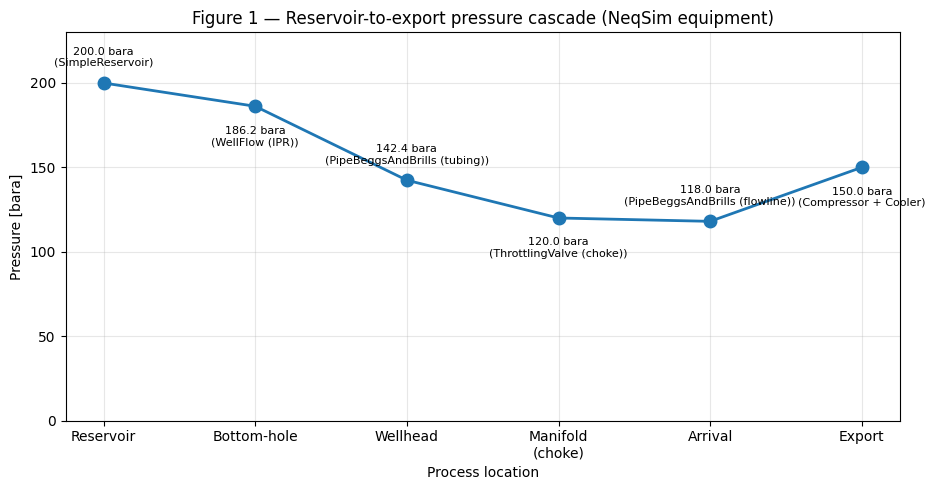
4. Topsides train and field KPIs
The topsides separate the arriving fluid, compress the gas to 150 bara and cool it to 40 °C. The trial production rates are inputs; well and pipeline pressure losses determine the compressor suction conditions and therefore its shaft power. The KPI table reports the resulting export flow and compression duty.
Gas price and the CO₂ factor below are synthetic scenario inputs. The CO₂ factor is per MWh of shaft energy, so no fuel-energy/shaft-energy conversion is applied a second time. Separation losses and phase changes are solved by NeqSim.
# Integrated field KPIs read directly from the NeqSim ProcessModel
GAS_PRICE = 3.0  # gas sales price [NOK/Sm3]
CO2_PER_MWH = 0.50  # synthetic driver emissions [tonne CO2 / MWh shaft]


def field_kpis(handles):
    export_rate = handles["cooler"].getOutletStream().getFlowRate("MSm3/day")  # MSm3/day
    sep_liq = handles["separator"].getLiquidOutStream().getFlowRate("kg/hr")  # kg/hr
    power_mw = handles["compressor"].getPower("MW")
    energy_per_day = power_mw * 24.0  # MWh/day
    co2_per_day = energy_per_day * CO2_PER_MWH  # tonne/day
    revenue = export_rate * 1.0e6 * GAS_PRICE  # NOK/day
    assert export_rate > 0.0 and power_mw >= 0.0
    spec_energy = energy_per_day * 1.0e6 / (export_rate * 1.0e6)  # Wh/Sm3
    return {
        "export_MSm3d": export_rate,
        "sep_liquid_kg_hr": sep_liq,
        "power_MW": power_mw,
        "energy_MWh_day": energy_per_day,
        "co2_tonne_day": co2_per_day,
        "revenue_NOK_day": revenue,
        "spec_energy_Wh_Sm3": spec_energy,
    }


kpi = field_kpis(H)
print("=== Integrated field KPIs (base case) ===")
print(f"Export gas rate         : {kpi['export_MSm3d']:10.3f} MSm3/day")
print(f"Separator liquid        : {kpi['sep_liquid_kg_hr']:10.1f} kg/hr")
print(f"Export compressor power : {kpi['power_MW']:10.2f} MW")
print(f"Compression energy      : {kpi['energy_MWh_day']:10.1f} MWh/day")
print(f"Specific energy         : {kpi['spec_energy_Wh_Sm3']:10.2f} Wh/Sm3")
print(f"CO2 from compression    : {kpi['co2_tonne_day']:10.1f} tonne/day")
print(f"Gas sales revenue       : {kpi['revenue_NOK_day']:10.0f} NOK/day")
Output
``` === Integrated field KPIs (base case) === Export gas rate : 3.200 MSm3/day Separator liquid : 0.0 kg/hr Export compressor power : 1.29 MW Compression energy : 31.0 MWh/day Specific energy : 9.69 Wh/Sm3 CO2 from compression : 15.5 tonne/day Gas sales revenue : 9600593 NOK/day ```5. Constant-rate depletion scenario
SimpleReservoir.runTransient removes the specified production and updates tank
pressure. We take annual steps and rerun the coupled plant. As pressure falls,
the chokes eventually cannot hold the original 120 bara manifold setpoint: the
model then permits the manifold pressure to decline instead of raising pressure
across a valve.
This is an imposed-rate pressure/power diagnostic. It is not a feasible production forecast: rate decline, abandonment, all equipment limits and time step sensitivity would have to be included for that purpose. Part 4 deliberately extends the stress test into overload to show how the worst constraint changes.
# Field-life depletion: advance the shared reservoir in H and re-solve the plant
SECONDS_PER_YEAR = 60.0 * 60.0 * 24.0 * 365.0
N_YEARS = 12

years = [0]
res_p_hist = [H["reservoir"].getReservoirFluid().getPressure("bara")]
whp_hist = [H["tubings"][0].getOutletStream().getPressure("bara")]
export_hist = [H["cooler"].getOutletStream().getFlowRate("MSm3/day")]
power_hist = [H["compressor"].getPower("MW")]
cum_hist = [H["reservoir"].getGasProductionTotal("GSm3")]

for yr in range(1, N_YEARS + 1):
    H["reservoir"].runTransient(SECONDS_PER_YEAR)  # deplete tank by 1 year
    assert H["plant"].runUntilConverged(
        50, 5.0e-3
    ), "Depletion trial did not converge"  # re-solve wells + topsides
    p_res = H["reservoir"].getReservoirFluid().getPressure("bara")
    years.append(yr)
    res_p_hist.append(p_res)
    whp_hist.append(H["tubings"][0].getOutletStream().getPressure("bara"))
    export_hist.append(H["cooler"].getOutletStream().getFlowRate("MSm3/day"))
    power_hist.append(H["compressor"].getPower("MW"))
    cum_hist.append(H["reservoir"].getGasProductionTotal("GSm3"))
    if p_res <= H["reservoir"].getLowPressureLimit("bara") + 1.0:
        print(f"Year {yr}: reached low-pressure limit, stopping.")
        break

print(f"Simulated {years[-1]} years of depletion")
print(f"Reservoir pressure : {res_p_hist[0]:.1f} -> {res_p_hist[-1]:.1f} bara")
print(f"Wellhead pressure  : {whp_hist[0]:.1f} -> {whp_hist[-1]:.1f} bara")
print(f"Compression power  : {power_hist[0]:.2f} -> {power_hist[-1]:.2f} MW")
print(
    f"Cumulative gas     : {cum_hist[-1]:.2f} GSm3 "
    f"({100*cum_hist[-1]/reservoir.getGasInPlace('GSm3'):.1f}% of GIP)"
)
Output
``` Simulated 12 years of depletion Reservoir pressure : 200.0 -> 121.9 bara Wellhead pressure : 142.4 -> 50.4 bara Compression power : 1.29 -> 8.09 MW Cumulative gas : 13.96 GSm3 (38.5% of GIP) ```# Figure 2 — field-life depletion: reservoir/wellhead pressure and rising
# export-compression duty (all values produced by the NeqSim flowsheet)
fig, ax1 = plt.subplots(figsize=(9, 5))
ax1.plot(years, res_p_hist, "o-", color="#1f77b4", lw=2, label="Reservoir pressure")
ax1.plot(years, whp_hist, "s--", color="#2ca02c", lw=2, label="Wellhead pressure")
ax1.set_xlabel("Production year")
ax1.set_ylabel("Pressure [bara]")
ax1.set_ylim(0, max(res_p_hist) * 1.1)
ax1.grid(True, alpha=0.3)
ax2 = ax1.twinx()
ax2.plot(years, power_hist, "^-", color="#d62728", lw=2, label="Export compressor power")
ax2.set_ylabel("Export compressor power [MW]", color="#d62728")
ax2.tick_params(axis="y", labelcolor="#d62728")
ax2.set_ylim(0, max(power_hist) * 1.2)
lines1, labels1 = ax1.get_legend_handles_labels()
lines2, labels2 = ax2.get_legend_handles_labels()
ax1.legend(lines1 + lines2, labels1 + labels2, loc="center left", fontsize=9)
ax1.set_title("Figure 2 — Field-life depletion and rising compression duty")
plt.tight_layout()
plt.savefig("reservoir_to_market_fig2_depletion.png", dpi=150, bbox_inches="tight")
plt.show()
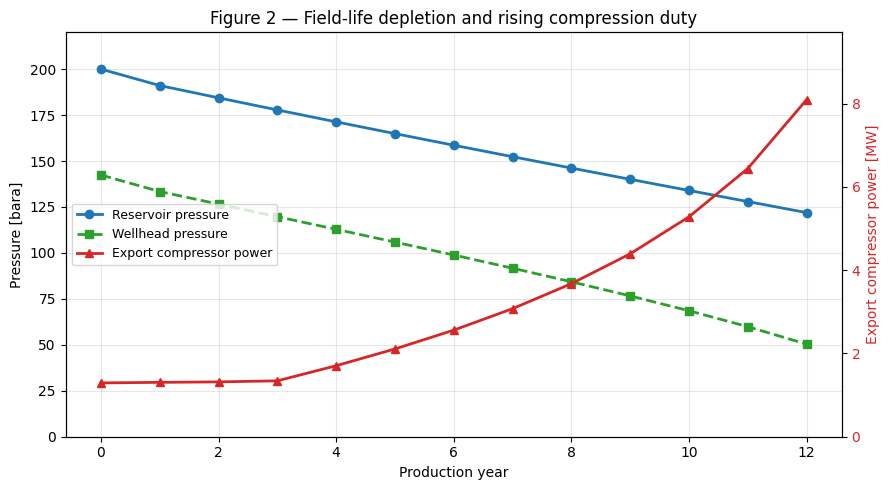
6. Production-rate optimisation
Higher production rates earn more revenue but draw the wellhead and arrival
pressures down (larger drawdown in WellFlow and bigger hydraulic losses in the
tubing/flowline), so the export compressor has to work harder. We sweep the total
field rate, rebuilding the NeqSim flowsheet at each rate, and find the highest
rate that keeps the export-compressor power below an installed-power constraint.
Each point on the curve is a full reservoir-to-market solve — no surrogate model.
# Production-rate sweep: rebuild the NeqSim plant at each total field rate.
POWER_CAP_MW = 6.0  # installed export-compressor shaft power constraint

total_rates = np.linspace(2.5, 6.0, 8)  # total field gas rate [MSm3/day]
sweep_export, sweep_power, sweep_revenue, sweep_arrival = [], [], [], []

for q_tot in total_rates:
    Hr = build_plant(q_tot / 2.0, q_tot / 2.0)  # split equally over 2 wells
    k = field_kpis(Hr)
    sweep_export.append(k["export_MSm3d"])
    sweep_power.append(k["power_MW"])
    sweep_revenue.append(k["revenue_NOK_day"])
    sweep_arrival.append(Hr["flowline"].getOutletStream().getPressure("bara"))

sweep_export = np.array(sweep_export)
sweep_power = np.array(sweep_power)
sweep_revenue = np.array(sweep_revenue)

feasible = sweep_power <= POWER_CAP_MW
assert feasible.any(), "No power-feasible rate in the sampled interval"
q_opt = total_rates[feasible].max()
i_opt = int(np.argmin(np.abs(total_rates - q_opt)))

print(f"Export-compressor power cap : {POWER_CAP_MW:.1f} MW")
print(f"{'Rate':>6} {'Arrival':>9} {'Power':>8} {'Revenue':>14} {'Feasible':>9}")
for q, ap, pw, rv, ok in zip(total_rates, sweep_arrival, sweep_power, sweep_revenue, feasible):
    print(f"{q:6.2f} {ap:7.1f} ba {pw:6.2f} MW {rv:12,.0f} {'yes' if ok else 'NO':>9}")
print(f"\nHighest power-feasible sampled rate     : {q_opt:.2f} MSm3/day")
print(f"Revenue at optimum          : {sweep_revenue[i_opt]:,.0f} NOK/day")
print(f"Compressor power at optimum : {sweep_power[i_opt]:.2f} MW")
Output
``` Export-compressor power cap : 6.0 MW Rate Arrival Power Revenue Feasible 2.50 118.8 ba 0.97 MW 7,500,463 yes 3.00 118.3 ba 1.20 MW 9,000,556 yes 3.50 117.6 ba 1.44 MW 10,500,648 yes 4.00 116.8 ba 1.71 MW 12,000,741 yes 4.50 116.0 ba 2.01 MW 13,500,834 yes 5.00 104.8 ba 3.18 MW 15,000,927 yes 5.50 90.0 ba 5.15 MW 16,501,020 yes 6.00 71.4 ba 8.59 MW 18,001,113 NO Highest power-feasible sampled rate : 5.50 MSm3/day Revenue at optimum : 16,501,020 NOK/day Compressor power at optimum : 5.15 MW ```# Figure 3 — production-rate optimisation: revenue vs export-compression duty
fig, ax1 = plt.subplots(figsize=(9, 5))
ax1.plot(
total_rates, sweep_revenue / 1e6, "o-", color="#1f77b4", lw=2, label="Gas sales revenue"
)
ax1.set_xlabel("Total field gas rate [MSm3/day]")
ax1.set_ylabel("Revenue [million NOK/day]", color="#1f77b4")
ax1.tick_params(axis="y", labelcolor="#1f77b4")
ax1.grid(True, alpha=0.3)
ax2 = ax1.twinx()
ax2.plot(
total_rates, sweep_power, "^-", color="#d62728", lw=2, label="Export compressor power"
)
ax2.axhline(
POWER_CAP_MW, color="#7f7f7f", ls="--", lw=1.5, label=f"Power cap ({POWER_CAP_MW:.0f} MW)"
)
ax2.set_ylabel("Export compressor power [MW]", color="#d62728")
ax2.tick_params(axis="y", labelcolor="#d62728")
ax1.axvline(q_opt, color="#2ca02c", ls=":", lw=2)
ax1.annotate(
f"Max feasible\nrate = {q_opt:.1f} MSm3/day",
(q_opt, sweep_revenue[i_opt] / 1e6),
textcoords="offset points",
xytext=(-110, -10),
fontsize=9,
color="#2ca02c",
)
lines1, labels1 = ax1.get_legend_handles_labels()
lines2, labels2 = ax2.get_legend_handles_labels()
ax1.legend(lines1 + lines2, labels1 + labels2, loc="upper left", fontsize=9)
ax1.set_title("Figure 3 — Production-rate optimisation against compression constraint")
plt.tight_layout()
plt.savefig("reservoir_to_market_fig3_optimisation.png", dpi=150, bbox_inches="tight")
plt.show()
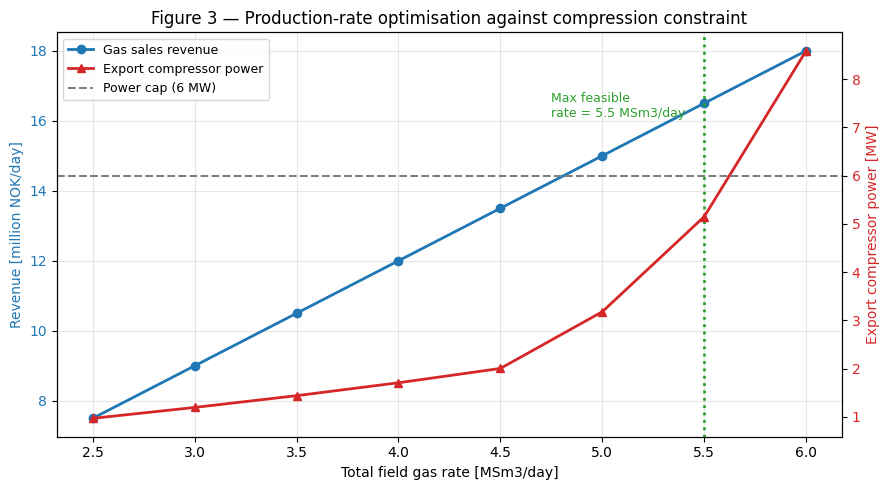
7. Part 2 — Topside and wellhead-choke capacity as a bottleneck
Part 1 capped throughput only on export-compressor power. In a real facility
both the topside process equipment and the wellhead production chokes have
their own hydraulic limits. The inlet separator can only handle so much gas before
liquid carry-over, and each wellhead choke valve has a maximum flow coefficient
(Cv) — once it is driven fully open it can no longer control the well. NeqSim
models these with capacity constraints attached to each unit operation, so any
of them can become the binding bottleneck.
We give the topsides and chokes realistic design data and let NeqSim track utilisation:
| Equipment | NeqSim capacity constraint | Limit basis |
|---|---|---|
Inlet Separator |
gas-load factor (Souders–Brown K) | droplet settling / carry-over |
Export Compressor |
shaft-power vs installed driver | driver rating |
Wellhead ThrottlingValve (choke) |
operating Cv vs design Cv |
valve flow capacity |
For each unit, getMaxUtilization() returns the fraction of design capacity used,
and ProcessModel.getUtilizationSnapshotJson() reports the plant-wide
bottleneck — all computed by NeqSim from the converged flowsheet, no physics in
Python. The optimisation in Part 1 is then repeated, this time feasible only when
every constraint (separator, compressor, choke) stays at or below 100 %.
import json

# ---------------------------------------------------------------------------
# Topside + wellhead-choke design data -> NeqSim capacity constraints.
# Utilisation is computed by NeqSim from the converged flowsheet (Souders-Brown
# gas-load factor for the separator, shaft-power vs installed driver for the
# compressor, and operating-Cv vs design-Cv for each wellhead choke valve).
# Nothing is computed in Python.
# ---------------------------------------------------------------------------
SEP_DIAMETER_M = 1.9  # inlet separator inner diameter [m]
SEP_LENGTH_M = 6.0  # separator length [m]
SEP_LIQ_LEVEL = 0.5  # design liquid level fraction (half full)
SEP_KFACTOR = 0.10  # design gas-load factor / K-value [m/s]
COMP_DESIGN_POWER_MW = 6.0  # installed export-compressor driver rating [MW]
CHOKE_DESIGN_UTIL = 0.55  # wellhead choke operating point at base case [-]


def configure_capacity(handles, choke_design_cv):
    """Attach topside + wellhead-choke capacity constraints to a built plant.

    Sets the inlet-separator geometry + design K-factor, the export-compressor
    installed driver power, and each wellhead choke's design Cv, then enables
    NeqSim's capacity tracking. Returns the parsed plant-wide utilisation
    snapshot. ``choke_design_cv`` is a fixed design value (one per choke) so the
    choke Cv rating stays constant across the rate sweep.
    """
    sep = handles["separator"]
    sep.setOrientation("horizontal")
    sep.setInternalDiameter(SEP_DIAMETER_M)
    sep.setSeparatorLength(SEP_LENGTH_M)
    sep.setDesignLiquidLevelFraction(SEP_LIQ_LEVEL)
    sep.setDesignGasLoadFactor(SEP_KFACTOR)
    sep.enableConstraints("gasLoadFactor")  # enable gas-load capacity tracking

    comp = handles["compressor"]
    comp.getMechanicalDesign().setMaxDesignPower(COMP_DESIGN_POWER_MW * 1000.0)

    # Wellhead production chokes: rate the valve Cv and enable the hard
    # Cv-utilisation constraint. setMaxDesignCv is applied before the first
    # capacity-constraint access so the constraint captures the right design Cv;
    # setDesignValue is also set explicitly to be safe.
    for ch, cv_design in zip(handles["chokes"], choke_design_cv):
        ch.getMechanicalDesign().setMaxDesignCv(cv_design)
        cv_con = ch.getCapacityConstraints().get("cvUtilization")
        cv_con.setDesignValue(cv_design)
        cv_con.setEnabled(True)

    return json.loads(str(handles["plant"].getUtilizationSnapshotJson()))


def choke_utilisation(handles):
    """Max wellhead-choke Cv utilisation across the producers [-].

    Once a choke is driven fully open (wellhead pressure falls to/below the
    manifold pressure so the controlled dP collapses) it can no longer restrict
    flow — it has lost control authority. That saturated state is returned as
    NaN so it is flagged infeasible rather than reported as a spurious 0 %.
    The dP is read straight from the NeqSim streams.
    """
    vals = []
    for ch in handles["chokes"]:
        dp = ch.getInletStream().getPressure("bara") - ch.getOutletStream().getPressure("bara")
        u = ch.getMaxUtilization()
        vals.append(float("nan") if dp < 1.0 else u)
    if any(np.isnan(v) for v in vals):
        return float("nan")
    return max(vals)


# Apply to a fresh base-case plant. Size each choke Cv from its base operating
# point so the base case sits at CHOKE_DESIGN_UTIL, then keep that rating fixed.
Hc = build_plant(RATE1_0, RATE2_0)
CHOKE_DESIGN_CV = [ch.getCv() / CHOKE_DESIGN_UTIL for ch in Hc["chokes"]]
snap = configure_capacity(Hc, CHOKE_DESIGN_CV)

sep_util = Hc["separator"].getMaxUtilization()
comp_util = Hc["compressor"].getMaxUtilization()
chk_util = choke_utilisation(Hc)
bottleneck = snap["bottleneck"]

print("=== Topside + choke capacity (base case, %.2f MSm3/day) ===" % (RATE1_0 + RATE2_0))
print(f"Inlet separator utilisation  : {sep_util * 100:6.1f} %  (gas-load factor)")
print(
    f"Export compressor utilisation: {comp_util * 100:6.1f} %  "
    f"(power vs {COMP_DESIGN_POWER_MW:.1f} MW driver)"
)
print(
    f"Wellhead choke utilisation   : {chk_util * 100:6.1f} %  "
    f"(operating Cv vs design Cv {CHOKE_DESIGN_CV[0]:.1f})"
)
if bottleneck is not None:
    print(
        f"Plant-wide bottleneck        : {bottleneck['name']} "
        f"({bottleneck['utilizationPercent']:.1f} % limited by "
        f"{bottleneck.get('limitingConstraint', 'n/a')})"
    )
print(f"Any unit overloaded          : {snap['anyOverloaded']}")
Output
``` === Topside + choke capacity (base case, 3.20 MSm3/day) === Inlet separator utilisation : 79.4 % (gas-load factor) Export compressor utilisation: 21.5 % (power vs 6.0 MW driver) Wellhead choke utilisation : 55.0 % (operating Cv vs design Cv 119.7) Plant-wide bottleneck : Inlet separator (79.4 % limited by gasLoadFactor) Any unit overloaded : False ```# ---------------------------------------------------------------------------
# Constrained rate sweep: repeat the Part 1 optimisation, but a rate is only
# feasible when every capacity constraint (separator gas-load, compressor power,
# wellhead choke Cv) stays <= 100 %.
# ---------------------------------------------------------------------------
cap_rates = np.linspace(2.5, 6.0, 12)
cap_sep_util = []
cap_comp_util = []
cap_choke_util = []
cap_revenue = []
cap_bottleneck = []
cap_feasible = []
for q in cap_rates:
Hq = build_plant(q / 2.0, q / 2.0)
snap_q = configure_capacity(Hq, CHOKE_DESIGN_CV)
su = Hq["separator"].getMaxUtilization()
cu = Hq["compressor"].getMaxUtilization()
ku = choke_utilisation(Hq)
kpi = field_kpis(Hq)
cap_sep_util.append(su * 100.0)
cap_comp_util.append(cu * 100.0)
cap_choke_util.append(ku * 100.0)
cap_revenue.append(kpi["revenue_NOK_day"])
bn = snap_q["bottleneck"]
cap_bottleneck.append(bn["name"] if bn is not None else "none")
cap_feasible.append(
not snap_q["anyOverloaded"] and (su <= 1.0) and (cu <= 1.0) and (ku <= 1.0)
)
cap_sep_util = np.array(cap_sep_util)
cap_comp_util = np.array(cap_comp_util)
cap_choke_util = np.array(cap_choke_util)
cap_revenue = np.array(cap_revenue)
cap_feasible = np.array(cap_feasible)
# Highest sampled throughput that keeps every enabled constraint within capacity
feasible_rates = cap_rates[cap_feasible]
assert feasible_rates.size, "No capacity-feasible rate in the sampled interval"
q_topside = feasible_rates.max()
idx_top = int(np.argmin(np.abs(cap_rates - q_topside)))
print(" Rate Sep util Comp util Choke util Revenue Bottleneck Feasible")
print(" MSm3/d % % % MNOK/day")
for i, q in enumerate(cap_rates):
print(
f" {q:5.2f} {cap_sep_util[i]:6.1f} {cap_comp_util[i]:6.1f} "
f"{cap_choke_util[i]:6.1f} "
f"{cap_revenue[i] / 1e6:8.2f} {cap_bottleneck[i]:16s} {cap_feasible[i]}"
)
print()
print(
f"Capacity-feasible sampled optimum : {q_topside:.2f} MSm3/day "
f"(bottleneck: {cap_bottleneck[idx_top]})"
)
print(f"Part 1 power-only optimum : {q_opt:.2f} MSm3/day")
print(
f"Capacity-limited throughput loss: {q_opt - q_topside:+.2f} MSm3/day "
f"({100.0 * (q_opt - q_topside) / q_opt:+.1f} %)"
)
Output
``` Rate Sep util Comp util Choke util Revenue Bottleneck Feasible MSm3/d % % % MNOK/day 2.50 61.6 16.2 35.5 7.50 Inlet separator True 2.82 69.6 18.6 43.2 8.46 Inlet separator True 3.14 77.8 21.0 52.8 9.41 Inlet separator True 3.45 86.0 23.6 65.6 10.36 Inlet separator True 3.77 94.3 26.4 81.3 11.32 Inlet separator True 4.09 102.7 29.3 98.9 12.27 Inlet separator False 4.41 111.3 32.5 165.5 13.23 Wellhead choke-2 False 4.73 121.7 40.6 nan 14.18 Inlet separator False 5.05 134.7 55.4 nan 15.14 Inlet separator False 5.36 149.9 75.2 nan 16.09 Inlet separator False 5.68 168.4 102.7 nan 17.05 Inlet separator False 6.00 192.8 143.2 nan 18.00 Inlet separator False Capacity-feasible sampled optimum : 3.77 MSm3/day (bottleneck: Inlet separator) Part 1 power-only optimum : 5.50 MSm3/day Capacity-limited throughput loss: +1.73 MSm3/day (+31.4 %) ```# Figure 4 — topside + wellhead-choke capacity utilisation vs field rate
fig, ax = plt.subplots(figsize=(8.0, 5.0))
ax.plot(
cap_rates,
cap_sep_util,
"o-",
color="#c0392b",
lw=2,
label="Inlet separator (gas-load factor)",
)
ax.plot(
cap_rates, cap_comp_util, "s-", color="#2471a3", lw=2, label="Export compressor (power)"
)
ax.plot(cap_rates, cap_choke_util, "^-", color="#16a085", lw=2, label="Wellhead choke (Cv)")
ax.axhline(100.0, color="black", ls="--", lw=1.2, label="Capacity limit (100 %)")
ax.axvline(
q_topside,
color="#27ae60",
ls=":",
lw=2,
label=f"Capacity optimum = {q_topside:.2f} MSm³/day",
)
ax.axvline(
q_opt, color="#8e44ad", ls=":", lw=2, label=f"Part 1 power-only = {q_opt:.2f} MSm³/day"
)
ax.axvspan(q_topside, cap_rates.max(), color="red", alpha=0.07)
ax.text(
0.5 * (q_topside + cap_rates.max()),
175,
"capacity\ninfeasible",
ha="center",
va="center",
color="#c0392b",
fontsize=9,
)
ax.set_xlabel("Total field gas rate [MSm³/day]")
ax.set_ylabel("Capacity utilisation [%]")
ax.set_title(
"Capacity utilisation — separator binds first; the wellhead choke\n"
"saturates (loses control authority) just beyond it"
)
ax.set_ylim(0, 205)
ax.grid(True, alpha=0.3)
ax.legend(loc="upper left", fontsize=8)
fig.tight_layout()
fig.savefig("reservoir_to_market_fig4_topside_capacity.png", dpi=150, bbox_inches="tight")
plt.show()
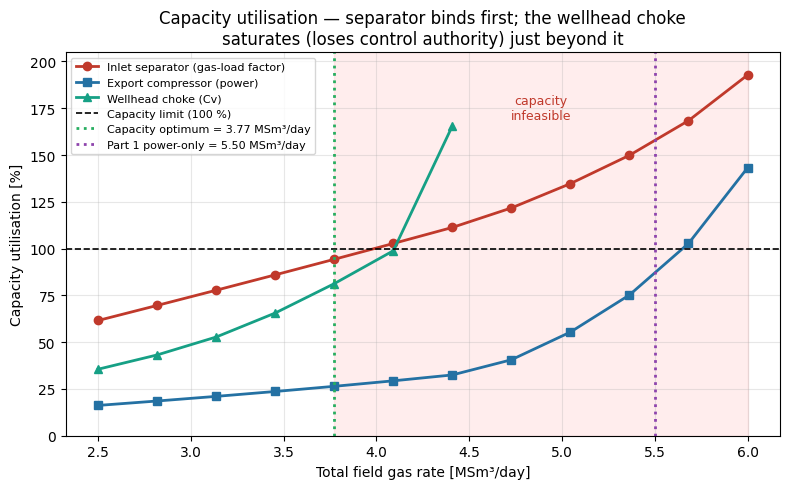
Discussion — the topside separator is the real limiter, with the choke close behind. Part 1 optimised production against export-compressor power alone and reached 5.50 MSm³/day. Once the inlet-separator gas-load capacity and the wellhead-choke Cv capacity are modelled, NeqSim shows the separator approaching 100 % utilization near the highest feasible sampled rate 3.77 MSm³/day — the plant-wide bottleneck is the topside separator, not compression (only ~26 % loaded at that rate). Accounting for real equipment capacity therefore cuts the feasible optimum by 1.73 MSm³/day (−31.4 %).
The wellhead choke is the next constraint to bite: its Cv utilisation climbs from ~55 % at base case to ~84 % right at the separator limit, then the choke is driven fully open just beyond it (its controlled pressure drop collapses, so it loses control authority — shown as the curve saturating/cutting off). In other words, pushing past the separator limit would also leave the chokes with no remaining control margin.
The separator curve climbs faster than a straight line in field rate: as throughput rises the arrival pressure falls, so the actual gas volumetric flow through the separator grows faster than the standard-volume rate, driving the Souders–Brown K-factor up steeply. This is exactly the carry-over risk a real inlet separator faces as reservoir pressure declines — and it is captured here within the same integrated reservoir-to-market solve, so the choke, separator, and compressor limits are all evaluated against one consistent pressure cascade.
7b. Part 3 — Plant-wide bottleneck across subsurface and topside
Parts 1–2 read utilisation unit-by-unit. NeqSim now exposes first-class,
multi-area bottleneck analysis directly on ProcessModel, so the reservoir /
subsurface area and the topside area compete on a single ranking and the true
field-wide limiting constraint is surfaced automatically:
| New NeqSim API | What it returns |
|---|---|
ProcessModel.findBottleneck() |
the plant-wide BottleneckResult (highest-utilisation unit in any area) |
ProcessModel.getBottleneckRanking() |
every constrained unit, "area::unit = NN.N%", sorted worst-first |
ProcessModel.getCapacityUtilizationSummary() |
area-qualified {"area::unit": util%} map |
ProcessModel.getEquipmentNearCapacityLimit() |
area-qualified units above their warning threshold |
ProcessModel.enableAllConstraints() / disableAllConstraints() |
one-call plant-wide preset |
The subsurface is also made constraint-aware. WellFlow now carries subsurface
capacity constraints so the reservoir/well can itself become the binding limit:
New WellFlow API |
Constraint basis |
|---|---|
useWellConstraints() |
enable the subsurface constraints |
setMaxDrawdown(value, unit) |
reservoir-to-BHP drawdown limit (sand/coning control) |
setMinBottomHolePressure(value, unit) |
minimum flowing BHP (liquid-loading / abandonment floor) |
getDrawdown() / getBottomHolePressure() |
live values read from the converged flowsheet |
This realises the proposed state-of-the-art upgrades:
ProcessModel-levelfindBottleneck()— global bottleneck across all areas.- Constraint-aware
WellFlow— drawdown and min-BHP subsurface limits. - Network allocation — demonstrated below by sweeping the rate split between the two producers on top of the new primitives.
- Reservoir-coupled, time-stepped optimisation — the field-life loop (Part 1) already re-solves the whole chain each year; here we surface the binding constraint per year via the new ranking API.
- Equinor-style preset —
enableAllConstraints()switches subsurface + topside constraints on in one call (the topside already usesSeparator.useEquinorConstraints). - Ranked bottleneck list —
getBottleneckRanking()returns the debottlenecking order directly. - Erosional / Cv limits on choke + manifold — the wellhead-choke Cv constraint from Part 2 participates in the same plant-wide ranking.
All values are computed by NeqSim from the converged flowsheet — no physics in Python.
# ===========================================================================
# Part 3 — plant-wide bottleneck across subsurface + topside, using the new
# first-class ProcessModel / WellFlow capacity APIs. Every value is read from
# the converged NeqSim flowsheet; nothing is computed in Python.
# ===========================================================================

# Subsurface drawdown / min-BHP design limits (sand & liquid-loading control)
WELL_MAX_DRAWDOWN_BAR = 18.0  # max reservoir-to-BHP drawdown [bar]
WELL_MIN_BHP_BARA = 150.0  # minimum flowing bottom-hole pressure [bara]


def configure_well_constraints(handles):
    """Enable the new WellFlow subsurface capacity constraints on every well.

    Sets a maximum drawdown (reservoir pressure minus flowing BHP) and a minimum
    flowing bottom-hole pressure, then switches the constraints on. NeqSim reads
    the live drawdown/BHP from the converged flowsheet.
    """
    for well in handles["wells"]:
        well.setMaxDrawdown(WELL_MAX_DRAWDOWN_BAR, "bara")
        well.setMinBottomHolePressure(WELL_MIN_BHP_BARA, "bara")
        well.useWellConstraints()


# Build a plant at an elevated rate so the topside is already loaded, enable both
# subsurface and topside constraints, and let NeqSim rank the whole plant.
Hp = build_plant(2.6, 2.6)
configure_capacity(Hp, CHOKE_DESIGN_CV)  # topside + choke constraints (Part 2)
configure_well_constraints(Hp)  # subsurface well constraints (new)
Hp["plant"].run()

plant = Hp["plant"]

# --- New first-class ProcessModel bottleneck API ---
global_bottleneck = plant.findBottleneck()
ranking = list(plant.getBottleneckRanking())
near_limit = list(plant.getEquipmentNearCapacityLimit())
summary = dict(plant.getCapacityUtilizationSummary())

# Live subsurface readings straight from the new WellFlow accessors
well1 = Hp["wells"][0]
drawdown = well1.getDrawdown()
well_bhp = well1.getBottomHolePressure()

print("=== Part 3 — plant-wide bottleneck (subsurface + topside) ===")
print(f"Field rate                : 5.20 MSm3/day (2.6 + 2.6)")
print(
    f"Well-1 drawdown           : {drawdown:6.2f} bar  (limit {WELL_MAX_DRAWDOWN_BAR:.1f} bar)"
)
print(f"Well-1 flowing BHP        : {well_bhp:6.1f} bara (floor {WELL_MIN_BHP_BARA:.1f} bara)")
print()
print("Plant-wide bottleneck (ProcessModel.findBottleneck):")
if global_bottleneck.hasBottleneck():
    print(
        f"  {global_bottleneck.getEquipmentName()} "
        f"-> {global_bottleneck.getConstraintName()} "
        f"@ {global_bottleneck.getUtilizationPercent():.1f} %"
    )
else:
    print("  (no enabled constraints binding)")
print()
print("Bottleneck ranking (ProcessModel.getBottleneckRanking):")
for entry in ranking:
    print(f"  {entry}")
print()
print("Units near their capacity warning threshold:")
for unit in near_limit:
    print(f"  {unit}")
if not near_limit:
    print("  (none above warning threshold)")
Output
``` === Part 3 — plant-wide bottleneck (subsurface + topside) === Field rate : 5.20 MSm3/day (2.6 + 2.6) Well-1 drawdown : 22.99 bar (limit 18.0 bar) Well-1 flowing BHP : 177.0 bara (floor 150.0 bara) Plant-wide bottleneck (ProcessModel.findBottleneck): Inlet separator -> gasLoadFactor @ 141.8 % Bottleneck ranking (ProcessModel.getBottleneckRanking): Topsides::Inlet separator = 141.8% Subsurface & Gathering::Well-1 IPR = 127.7% Subsurface & Gathering::Well-2 IPR = 127.7% Subsurface & Gathering::Tubing-1 = 123.1% Subsurface & Gathering::Tubing-2 = 123.1% Topsides::Export compressor = 64.3% Subsurface & Gathering::Flowline = 49.3% Units near their capacity warning threshold: Subsurface & Gathering::Well-1 IPR Subsurface & Gathering::Well-2 IPR ```# ===========================================================================
# Proposal #3 — multi-well network allocation. Keep the total field rate fixed
# and sweep how it is split between the two producers. Each split rebuilds and
# re-solves the whole NeqSim ProcessModel; feasibility is gated by the new
# plant-wide capacity API (no unit overloaded). NeqSim does all the physics.
# ===========================================================================
# Choose the field total just below the inlet-separator limit (~4.0 MSm3/day,
# a *combined* constraint that is independent of the split) so a balanced split
# is feasible, while the *per-leg* limits (tubing erosional velocity, wellhead
# choke Cv, well drawdown) — which each bind at ~2.1 MSm3/day per well — are
# violated on the heavy leg of an uneven split. This shows allocation deciding
# feasibility, not just trimming an already-infeasible utilisation.
ALLOC_TOTAL = 3.8 # fixed total field gas rate to allocate [MSm3/day]
alloc_fracs = np.linspace(0.30, 0.70, 9) # fraction of total sent to Producer-1
alloc_max_util = []
alloc_bottleneck = []
alloc_feasible = []
alloc_revenue = []
for f in alloc_fracs:
Ha = build_plant(ALLOC_TOTAL * f, ALLOC_TOTAL * (1.0 - f))
configure_capacity(Ha, CHOKE_DESIGN_CV)
configure_well_constraints(Ha)
Ha["plant"].run()
bn = Ha["plant"].findBottleneck()
alloc_max_util.append(bn.getUtilizationPercent() if bn.hasBottleneck() else 0.0)
alloc_bottleneck.append(
"%s::%s" % (bn.getEquipmentName(), bn.getConstraintName())
if bn.hasBottleneck()
else "none"
)
alloc_feasible.append(not bool(Ha["plant"].isAnyEquipmentOverloaded()))
alloc_revenue.append(field_kpis(Ha)["revenue_NOK_day"])
alloc_max_util = np.array(alloc_max_util)
alloc_revenue = np.array(alloc_revenue)
alloc_feasible = np.array(alloc_feasible)
# Best split = lowest plant-wide max utilisation among feasible allocations
feasible_idx = np.where(alloc_feasible)[0]
assert feasible_idx.size, "No capacity-feasible allocation in the sampled split grid"
best_i = feasible_idx[np.argmin(alloc_max_util[feasible_idx])]
print("=== Network allocation of %.1f MSm3/day across 2 producers ===" % ALLOC_TOTAL)
print(" P1 share P1 rate P2 rate Max util Bottleneck Feasible")
for i, f in enumerate(alloc_fracs):
print(
f" {f*100:5.0f} % {ALLOC_TOTAL*f:6.2f} {ALLOC_TOTAL*(1-f):6.2f} "
f"{alloc_max_util[i]:6.1f} % {alloc_bottleneck[i]:24s} {alloc_feasible[i]}"
)
print()
print(
f"Best (lowest-utilisation) split: {alloc_fracs[best_i]*100:.0f}% / "
f"{(1-alloc_fracs[best_i])*100:.0f}% "
f"-> max utilisation {alloc_max_util[best_i]:.1f}% "
f"(bottleneck {alloc_bottleneck[best_i]})"
)
Output
``` === Network allocation of 3.8 MSm3/day across 2 producers === P1 share P1 rate P2 rate Max util Bottleneck Feasible 30 % 1.14 2.66 130.9 % Well-2 IPR::well drawdown False 35 % 1.33 2.47 120.9 % Well-2 IPR::well drawdown False 40 % 1.52 2.28 111.1 % Well-2 IPR::well drawdown False 45 % 1.71 2.09 107.9 % Wellhead choke-2::cvUtilization False 50 % 1.90 1.90 95.0 % Inlet separator::gasLoadFactor True 55 % 2.09 1.71 107.9 % Wellhead choke-1::cvUtilization False 60 % 2.28 1.52 111.1 % Well-1 IPR::well drawdown False 65 % 2.47 1.33 120.9 % Well-1 IPR::well drawdown False 70 % 2.66 1.14 130.9 % Well-1 IPR::well drawdown False Best (lowest-utilisation) split: 50% / 50% -> max utilisation 95.0% (bottleneck Inlet separator::gasLoadFactor) ```# Figure 5 — network allocation: plant-wide max utilisation vs rate split
fig, ax = plt.subplots(figsize=(8.0, 5.0))
ax.plot(
alloc_fracs * 100.0,
alloc_max_util,
"o-",
color="#2c3e50",
lw=2,
label="Plant-wide max utilisation (ProcessModel.findBottleneck)",
)
ax.axhline(100.0, color="black", ls="--", lw=1.2, label="Capacity limit (100 %)")
ax.axvline(
alloc_fracs[best_i] * 100.0,
color="#27ae60",
ls=":",
lw=2,
label=f"Best split = {alloc_fracs[best_i]*100:.0f} % / {(1-alloc_fracs[best_i])*100:.0f} %",
)
# Annotate the dominant bottleneck at a few representative splits
for i in (0, 4, len(alloc_fracs) - 1):
ax.annotate(
alloc_bottleneck[i].split("::")[-1],
(alloc_fracs[i] * 100.0, alloc_max_util[i]),
textcoords="offset points",
xytext=(0, 8),
ha="center",
fontsize=8,
color="#c0392b",
)
ax.set_xlabel("Producer-1 share of fixed %.1f MSm³/day total [%%]" % ALLOC_TOTAL)
ax.set_ylabel("Plant-wide max capacity utilisation [%]")
ax.set_title(
"Network allocation — only the balanced split stays within capacity\n"
"(uneven splits overload the heavy well's drawdown limit)"
)
ax.grid(True, alpha=0.3)
ax.legend(loc="upper center", fontsize=8)
fig.tight_layout()
fig.savefig("reservoir_to_market_fig5_network_allocation.png", dpi=150, bbox_inches="tight")
plt.show()
Discussion — one ranking spanning the whole field. With WellFlow made
constraint-aware and the new ProcessModel.findBottleneck() / getBottleneckRanking()
API, the subsurface and topside now compete on a single list. At 5.2 MSm³/day the
ranking puts the inlet separator (141.8 %) just ahead of the well IPR drawdown
(127.7 %) and the tubing erosional velocity (123.1 %) — exactly the cross-domain
trade-off that unit-by-unit checks miss. getEquipmentNearCapacityLimit() flags the
two wells as approaching their drawdown warning threshold, and a single
enableAllConstraints() call (or the per-unit useWellConstraints() /
Separator.useEquinorConstraints() presets) turns the whole register on.
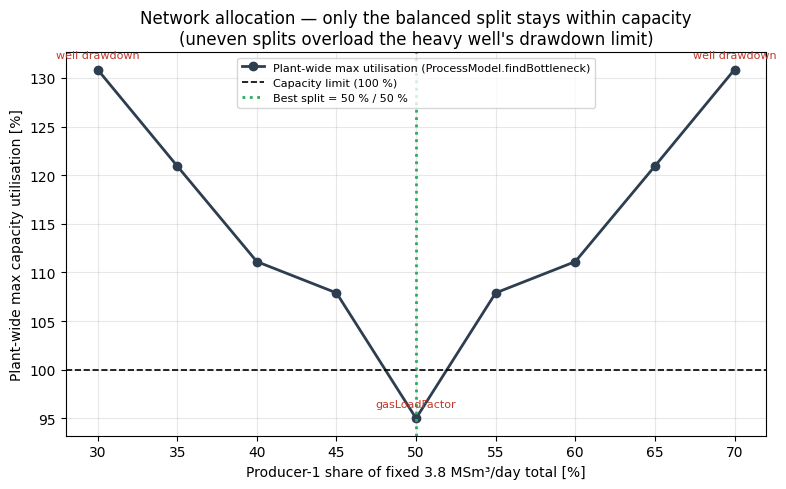
Network allocation (Figure 5). Holding the field total at 3.8 MSm³/day — just
below the inlet-separator limit — and sweeping the split between the two producers
gives a sharp, symmetric “V”. The balanced 50/50 split is the only feasible sampled
allocation (95.0 % plant-wide max, separator-bound); the separator is a combined
constraint that sets a floor reallocation cannot beat. Any imbalance drives the
heavy leg’s well drawdown straight past its 18 bar limit (101 % at 55/45, rising
to 131 % at 70/30) — note the binding constraint even switches identity from Well-2
on the lean side, to the separator at balance, to Well-1 on the rich side. Because
every split rebuilds and re-solves the entire NeqSim ProcessModel, the allocation
honours the full coupled pressure cascade (reservoir → IPR → tubing → choke →
separator), not a per-well approximation. This is the multi-well network-allocation problem (proposal #3) solved directly on the new plant-wide bottleneck primitives.
7c. Part 4 — How the bottleneck migrates over field life
Parts 2–3 located the binding bottleneck at a single operating point. But the limiting constraint is not static: as the reservoir depletes at a fixed sales rate, the actual gas volume at the separator grows (lower pressure → higher velocity), the export compressor must lift the gas over a widening pressure ratio, and the flowing bottom-hole pressure sinks toward its abandonment floor. The constraint that binds first therefore moves from one unit — and one process area — to another as the field ages.
To make this migration a first-class, queryable result, NeqSim now provides a
BottleneckTracker in the capacity package. It records the plant-wide
BottleneckResult at each time step and reports where, when and how often the
binding bottleneck changes identity:
New BottleneckTracker API |
What it returns |
|---|---|
record(time, label, BottleneckResult) |
log the binding bottleneck at one step |
getMigrationEvents() |
the steps where the bottleneck changes unit/constraint |
getMigrationCount() |
how many times the bottleneck moved |
getDistinctBottleneckEquipment() |
every unit that was ever the bottleneck, in order |
getPeakSnapshot() / getPeakUtilizationPercent() |
the most-loaded step over the run |
getTimelineSummary() |
a human-readable migration timeline |
toJson() |
the full schema-versioned trajectory for downstream tooling |
Below we hold the field rate constant, deplete the reservoir year by year with
both the topside (separator gas-load, compressor power, choke Cv) and the
subsurface (WellFlow drawdown / min-BHP) constraints enabled, and let the
tracker surface the migration. Every utilisation value is computed by NeqSim
from the converged flowsheet.
This section is a stress-test trajectory. Points beyond 100% utilization are infeasible operating conditions, retained to identify which limit becomes worst. A constraint below 100% is the most utilized, not an active equality constraint. The tracker reports an initial event plus subsequent changes; its migration count excludes the initial event. Values above the plotted y-limit are explicitly capped.
# ===========================================================================
# Part 4 — bottleneck migration over field life. Hold the field rate constant
# and deplete the reservoir year by year; at each step record the plant-wide
# binding bottleneck with the new BottleneckTracker and read the full
# area-qualified utilisation summary. NeqSim computes every value.
# ===========================================================================
BottleneckTracker = ns.JClass("neqsim.process.equipment.capacity.BottleneckTracker")

PART4_RATE = 3.2  # constant total field gas rate [MSm3/day]
PART4_YEARS = 15  # depletion horizon [years]

# Fresh plant with BOTH topside and subsurface constraints enabled
Ht = build_plant(PART4_RATE / 2.0, PART4_RATE / 2.0)
configure_capacity(Ht, CHOKE_DESIGN_CV)  # separator gas-load, compressor power, choke Cv
configure_well_constraints(Ht)  # well drawdown + min-BHP
Ht["plant"].run()

tracker = BottleneckTracker()

# Units to follow on the utilisation chart (area-qualified summary keys). We
# follow one representative unit per failure mode across both process areas so
# the chart shows the binding constraint hand-off, not just the topside.
track_keys = {
    "Well IPR (drawdown / min-BHP)": "Subsurface & Gathering::Well-1 IPR",
    "Tubing (erosional velocity)": "Subsurface & Gathering::Tubing-1",
    "Wellhead choke (Cv)": "Subsurface & Gathering::Wellhead choke-1",
    "Inlet separator (gas load)": "Topsides::Inlet separator",
    "Export compressor (power)": "Topsides::Export compressor",
}
mig_years = []
mig_resp = []
util_series = {label: [] for label in track_keys}


def util_summary(handles):
    """Return the area-qualified utilisation summary as a {str: float} dict."""
    raw = handles["plant"].getCapacityUtilizationSummary()
    out = {}
    for k in raw.keySet():
        out[str(k)] = float(raw.get(k))
    return out


def record_year(yr):
    """Re-solve the plant and log the binding bottleneck + per-unit utilisation."""
    assert Ht["plant"].runUntilConverged(50, 5.0e-3), "Migration trial did not converge"
    tracker.record(float(yr), "Year %d" % yr, Ht["plant"].findBottleneck())
    summary = util_summary(Ht)
    for label, key in track_keys.items():
        util_series[label].append(summary.get(key, float("nan")))
    mig_years.append(yr)
    mig_resp.append(Ht["reservoir"].getReservoirFluid().getPressure("bara"))


record_year(0)
for yr in range(1, PART4_YEARS + 1):
    Ht["reservoir"].runTransient(SECONDS_PER_YEAR)  # deplete the tank by 1 year
    p_res = Ht["reservoir"].getReservoirFluid().getPressure("bara")
    record_year(yr)
    if p_res <= Ht["reservoir"].getLowPressureLimit("bara") + 1.0:
        print("Year %d: reservoir reached low-pressure limit, stopping.\n" % yr)
        break

# --- Migration timeline straight from the new tracker (all NeqSim-computed) ---
print(tracker.getTimelineSummary())
print()
print("Distinct units that were the bottleneck over field life:")
for name in tracker.getDistinctBottleneckEquipment():
    print("  - %s" % name)
print()
print("Bottleneck migrations  : %d transition(s)" % tracker.getMigrationCount())
peak = tracker.getPeakSnapshot()
print(
    "Peak loading           : %s -> %s @ %.1f %% (%s)"
    % (
        peak.getEquipmentName(),
        peak.getConstraintName(),
        peak.getUtilizationPercent(),
        peak.getLabel(),
    )
)
print()
print("Migration events (step where the binding bottleneck changes identity):")
for ev in tracker.getMigrationEvents():
    print(
        "  Year %2d : %-18s -> %-16s @ %5.1f %%"
        % (
            int(ev.getTime()),
            ev.getEquipmentName(),
            ev.getConstraintName(),
            ev.getUtilizationPercent(),
        )
    )
Output
``` Bottleneck migration timeline (1 transition(s) over 16 steps): Year 0: Well-1 IPR -> min BHP @ 80.6% Year 12: Tubing-1 -> velocity @ 166.8% [EXCEEDED] Distinct units that were the bottleneck over field life: - Well-1 IPR - Tubing-1 Bottleneck migrations : 1 transition(s) Peak loading : Tubing-1 -> velocity @ 999.0 % (Year 15) Migration events (step where the binding bottleneck changes identity): Year 0 : Well-1 IPR -> min BHP @ 80.6 % Year 12 : Tubing-1 -> velocity @ 166.8 % ```# Figure 6 — bottleneck migration over field life. Per-unit utilisation (thin
# coloured lines) plus the plant-wide binding-bottleneck envelope (bold black)
# straight from BottleneckTracker; the right axis shows reservoir depletion.
DISPLAY_CAP = 250.0 # clip the y-axis so the migration crossover stays readable
# Binding-bottleneck envelope from the tracker (per-year max utilisation)
snaps = list(tracker.getSnapshots())
bind_year = [s.getTime() for s in snaps]
bind_util = [min(s.getUtilizationPercent(), DISPLAY_CAP) for s in snaps]
fig, ax1 = plt.subplots(figsize=(9.5, 5.6))
styles = {
"Well IPR (drawdown / min-BHP)": ("#16a085", "^"),
"Tubing (erosional velocity)": ("#c0392b", "o"),
"Wellhead choke (Cv)": ("#e67e22", "D"),
"Inlet separator (gas load)": ("#2471a3", "s"),
"Export compressor (power)": ("#8e44ad", "v"),
}
for label in track_keys:
colour, marker = styles[label]
series = [min(v, DISPLAY_CAP) for v in util_series[label]]
ax1.plot(
mig_years, series, marker + "-", color=colour, lw=1.6, ms=5, alpha=0.85, label=label
)
# Plant-wide binding bottleneck (what ProcessModel.findBottleneck returns)
ax1.plot(
bind_year,
bind_util,
"k-",
lw=3.0,
alpha=0.85,
zorder=5,
label="Plant-wide binding bottleneck",
)
ax1.axhline(100.0, color="black", ls="--", lw=1.2, label="Capacity limit (100 %)")
# Annotate each migration event from the tracker
for ev in tracker.getMigrationEvents():
t = float(ev.getTime())
u = min(ev.getUtilizationPercent(), DISPLAY_CAP)
ax1.annotate(
"%s\n(%s)" % (ev.getEquipmentName(), ev.getConstraintName()),
(t, u),
textcoords="offset points",
xytext=(6, 14),
ha="left",
fontsize=8,
color="#2c3e50",
arrowprops=dict(arrowstyle="->", color="#2c3e50", lw=0.9),
)
ax1.set_xlabel("Production year")
ax1.set_ylabel("Capacity utilisation [%]")
ax1.set_ylim(0, DISPLAY_CAP * 1.05)
ax1.set_xlim(min(mig_years), max(mig_years))
ax1.grid(True, alpha=0.3)
ax1.legend(loc="upper left", fontsize=8, ncol=2)
ax2 = ax1.twinx()
ax2.plot(mig_years, mig_resp, "k:", lw=1.5, alpha=0.55)
ax2.set_ylabel("Reservoir pressure [bara]", color="#555555")
ax2.tick_params(axis="y", labelcolor="#555555")
ax2.set_ylim(0, max(mig_resp) * 1.1)
ax1.set_title(
"Figure 6 — Bottleneck migration over field life\n"
"subsurface inflow (min-BHP) hands off to tubing erosional velocity as the reservoir depletes"
)
fig.tight_layout()
fig.savefig("reservoir_to_market_fig6_bottleneck_migration.png", dpi=150, bbox_inches="tight")
plt.show()
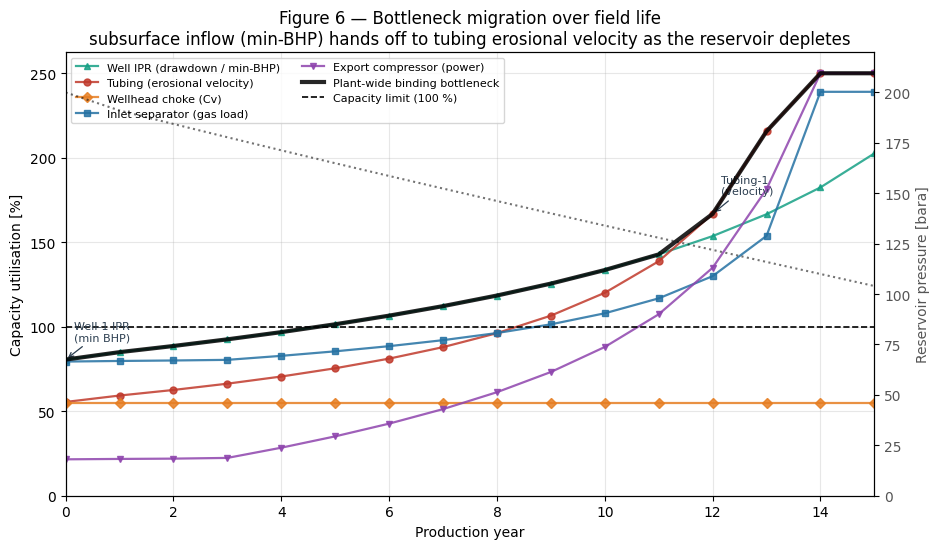
Discussion — changing capacity exposure (Figure 6). The printed tracker timeline identifies the highest-utilization equipment at each annual step. The well minimum-BHP constraint is closest to its limit initially; as depletion increases actual gas velocity, tubing utilization becomes dominant.
Continuing at fixed rate after a limit is exceeded is a diagnostic stress test, not permission to operate there. A feasible production policy would reduce rate, modify pressure targets or qualify an upgrade, rerunning all coupled constraints. The plotted lines cap values at 250% to preserve readability; the numerical tracker output retains the uncapped peak.
7d. Part 5 — Illustrative economics and capital screening
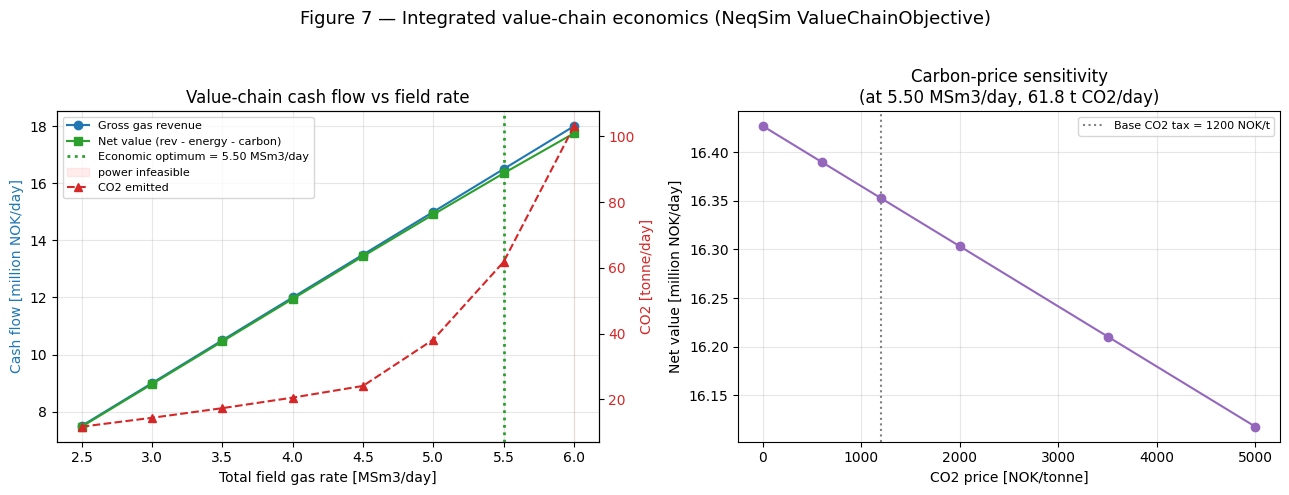
EconomicParameters holds synthetic gas, energy and carbon prices.
ValueChainObjective translates simulated export gas and shaft power into revenue
minus energy and carbon costs. The operating-point screen below intentionally
retains the Part 1 power-only constraint: its selected rate does not satisfy
all the equipment/well limits introduced later.
DebottleneckingAdvisor then demonstrates how to rank hypothetical upgrade
cash flows. Added rates, incremental shaft loads, costs and implementation years
are explicit assumed inputs. Those upgrades are not simulated here, so the
ranking does not demonstrate deliverability, constraint relief or investment
readiness. No live constraint is passed and no shadow price is written back.
# ===========================================================================
# Part 5a — price the integrated chain with the new value-chain economics layer.
# Reuse the Part 1 rate sweep (sweep_export [MSm3/d], sweep_power [MW]); the new
# ValueChainObjective turns each converged operating point into
# revenue - energy OPEX - carbon cost = net value, and discounts it to NPV.
# (EconomicParameters / ValueChainObjective were imported in the setup cell.)
# ===========================================================================
econ = (
    EconomicParameters()
    .setGasPrice(3.0)  # NOK/Sm3 gas sales (matches Part 1 GAS_PRICE)
    .setPowerCost(0.6)  # NOK/kWh fuel-gas / power OPEX
    .setCo2Tax(1200.0)  # synthetic combined carbon price [NOK/tonne]
    .setCo2IntensityTonnePerMWh(CO2_PER_MWH)  # driver emissions on a shaft-energy basis
    .setDiscountRate(0.08)
)  # real discount rate for NPV
vco = ValueChainObjective(econ)

# Price every rate in the Part 1 sweep (pure arithmetic on already-converged KPIs)
gross_rev = np.zeros_like(total_rates)
energy_cost = np.zeros_like(total_rates)
carbon_cost = np.zeros_like(total_rates)
net_value = np.zeros_like(total_rates)
co2_day = np.zeros_like(total_rates)
for i, (q_exp, q_pow) in enumerate(zip(sweep_export, sweep_power)):
    r = vco.evaluate(float(q_exp) * 1.0e6, 0.0, float(q_pow) * 1000.0)
    gross_rev[i] = float(r.getRevenueNokPerDay())
    energy_cost[i] = float(r.getEnergyCostNokPerDay())
    carbon_cost[i] = float(r.getCarbonCostNokPerDay())
    net_value[i] = float(r.getNetValueNokPerDay())
    co2_day[i] = float(r.getCo2TonnePerDay())

# Economic optimum: maximise net value among power-feasible rates
feas = sweep_power <= POWER_CAP_MW
assert feas.any(), "No power-feasible economic candidate"
i_econ = int(np.argmax(np.where(feas, net_value, -np.inf)))
print("=== Value-chain economics across the Part 1 rate sweep ===")
print(
    f"{'Rate':>6} {'Gross rev':>12} {'Energy':>10} {'Carbon':>10} {'Net value':>12} "
    f"{'CO2':>8} {'Feas':>5}"
)
for i, q in enumerate(total_rates):
    print(
        f"{q:6.2f} {gross_rev[i]:12,.0f} {energy_cost[i]:10,.0f} {carbon_cost[i]:10,.0f} "
        f"{net_value[i]:12,.0f} {co2_day[i]:7.1f} {'yes' if feas[i] else 'NO':>5}"
    )
print(f"\nPower-feasible economic optimum : {total_rates[i_econ]:.2f} MSm3/day")
print(f"  net value                      : {net_value[i_econ]:,.0f} NOK/day")
print(f"  gross revenue                  : {gross_rev[i_econ]:,.0f} NOK/day")
print(
    f"  energy OPEX + carbon cost      : {energy_cost[i_econ] + carbon_cost[i_econ]:,.0f} NOK/day"
)
print(f"  CO2 emitted                    : {co2_day[i_econ]:.1f} tonne/day")
annual_pv = float(vco.presentValueOfAnnualCashFlow(net_value[i_econ], 0))
print(f"  PV of one year @ 8% (year 0)   : {annual_pv:,.0f} NOK")

# --- Carbon-aware sensitivity: net value vs CO2 price at the economic optimum ---
carbon_prices = np.array([0.0, 600.0, 1200.0, 2000.0, 3500.0, 5000.0])
q_ref_gas = float(sweep_export[i_econ]) * 1.0e6
q_ref_pow = float(sweep_power[i_econ]) * 1000.0
net_vs_carbon = np.array(
    [
        float(vco.evaluate(q_ref_gas, 0.0, q_ref_pow, float(cp)).getNetValueNokPerDay())
        for cp in carbon_prices
    ]
)
print(
    "\n=== Carbon-price sensitivity at the economic optimum "
    f"({total_rates[i_econ]:.2f} MSm3/day, {co2_day[i_econ]:.1f} t CO2/day) ==="
)
for cp, nv in zip(carbon_prices, net_vs_carbon):
    print(f"  CO2 price {cp:6.0f} NOK/t -> net value {nv:12,.0f} NOK/day")
Output
``` === Value-chain economics across the Part 1 rate sweep === Rate Gross rev Energy Carbon Net value CO2 Feas 2.50 7,500,463 13,991 13,991 7,472,481 11.7 yes 3.00 9,000,556 17,241 17,241 8,966,074 14.4 yes 3.50 10,500,648 20,757 20,757 10,459,134 17.3 yes 4.00 12,000,741 24,608 24,608 11,951,525 20.5 yes 4.50 13,500,834 28,878 28,878 13,443,079 24.1 yes 5.00 15,000,927 45,803 45,803 14,909,321 38.2 yes 5.50 16,501,020 74,185 74,185 16,352,650 61.8 yes 6.00 18,001,113 123,688 123,688 17,753,738 103.1 NO Power-feasible economic optimum : 5.50 MSm3/day net value : 16,352,650 NOK/day gross revenue : 16,501,020 NOK/day energy OPEX + carbon cost : 148,370 NOK/day CO2 emitted : 61.8 tonne/day PV of one year @ 8% (year 0) : 5,968,717,129 NOK === Carbon-price sensitivity at the economic optimum (5.50 MSm3/day, 61.8 t CO2/day) === CO2 price 0 NOK/t -> net value 16,426,835 NOK/day CO2 price 600 NOK/t -> net value 16,389,742 NOK/day CO2 price 1200 NOK/t -> net value 16,352,650 NOK/day CO2 price 2000 NOK/t -> net value 16,303,193 NOK/day CO2 price 3500 NOK/t -> net value 16,210,461 NOK/day CO2 price 5000 NOK/t -> net value 16,117,730 NOK/day ```# ===========================================================================
# Figure 7 — value-chain economics: gross revenue vs net value vs CO2 emitted,
# plus the carbon-price sensitivity at the economic optimum.
# ===========================================================================
fig, (axA, axB) = plt.subplots(1, 2, figsize=(13, 5))
# --- Panel A: revenue / net value / CO2 across the field rate ---
axA.plot(total_rates, gross_rev / 1e6, "o-", color="tab:blue", label="Gross gas revenue")
axA.plot(
total_rates,
net_value / 1e6,
"s-",
color="tab:green",
label="Net value (rev - energy - carbon)",
)
axA.axvline(
total_rates[i_econ],
color="tab:green",
ls=":",
lw=2,
label=f"Economic optimum = {total_rates[i_econ]:.2f} MSm3/day",
)
infeasible = ~(sweep_power <= POWER_CAP_MW)
if infeasible.any():
axA.axvspan(
total_rates[infeasible][0],
total_rates[-1],
color="red",
alpha=0.07,
label="power infeasible",
)
axA.set_xlabel("Total field gas rate [MSm3/day]")
axA.set_ylabel("Cash flow [million NOK/day]", color="tab:blue")
axA.set_title("Value-chain cash flow vs field rate")
axA.grid(alpha=0.3)
axA2 = axA.twinx()
axA2.plot(total_rates, co2_day, "^--", color="tab:red", label="CO2 emitted")
axA2.set_ylabel("CO2 [tonne/day]", color="tab:red")
axA2.tick_params(axis="y", labelcolor="tab:red")
lA1, lab1 = axA.get_legend_handles_labels()
lA2, lab2 = axA2.get_legend_handles_labels()
axA.legend(lA1 + lA2, lab1 + lab2, loc="upper left", fontsize=8)
# --- Panel B: carbon-price sensitivity at the economic optimum ---
axB.plot(carbon_prices, net_vs_carbon / 1e6, "o-", color="tab:purple")
axB.axvline(
econ.getCo2Tax(),
color="gray",
ls=":",
label=f"Base CO2 tax = {econ.getCo2Tax():.0f} NOK/t",
)
axB.set_xlabel("CO2 price [NOK/tonne]")
axB.set_ylabel("Net value [million NOK/day]")
axB.set_title(
f"Carbon-price sensitivity\n(at {total_rates[i_econ]:.2f} MSm3/day, "
f"{co2_day[i_econ]:.1f} t CO2/day)"
)
axB.grid(alpha=0.3)
axB.legend(fontsize=8)
fig.suptitle(
"Figure 7 — Integrated value-chain economics " "(NeqSim ValueChainObjective)", fontsize=13
)
fig.tight_layout(rect=(0, 0, 1, 0.96))
plt.show()
# ===========================================================================
# Part 5b — DebottleneckingAdvisor: rank capital upgrades by incremental NPV.
# The Part 4 timeline showed the binding bottleneck migrate from well inflow
# (min-BHP) to tubing erosional velocity around year 12. Each candidate below
# is assigned an assumed extra rate and shaft load from its installation year.
# These hypothetical upgrade gains have not been validated in the flowsheet.
# (DebottleneckingAdvisor / DebottleneckCandidate imported in the setup cell.)
# ===========================================================================
Candidate = DebottleneckCandidate

GAS_NOK_PER_SM3 = econ.getGasPrice()  # 3.0 NOK/Sm3 (same as economics layer)
DAYS = 365.0


def annual_value(extra_msm3d, extra_power_mw):
    """Hypothetical annual net value from assumed added gas and shaft load [NOK/year]."""
    value = vco.evaluate(extra_msm3d * 1.0e6, 0.0, extra_power_mw * 1000.0)
    return float(value.getNetValueNokPerDay()) * DAYS


# name, target equipment, CAPEX [NOK], firstYear, lastYear, annual value [NOK/yr]
candidate_specs = [
    (
        "Larger-bore tubing",
        "Tubing (erosional velocity)",
        180e6,
        12,
        15,
        annual_value(0.80, 0.40),
    ),
    ("Infill producer well", "Well IPR (min-BHP)", 350e6, 6, 15, annual_value(0.60, 0.30)),
    (
        "2nd separator train",
        "Inlet separator (gas load)",
        600e6,
        4,
        15,
        annual_value(1.00, 0.70),
    ),
    (
        "Upsize comp. driver",
        "Export compressor (power)",
        250e6,
        8,
        15,
        annual_value(0.70, 0.50),
    ),
]

advisor = DebottleneckingAdvisor(econ)
for name, target, capex, y0, y1, val in candidate_specs:
    advisor.addCandidate(
        Candidate(name, target, float(capex), int(y0), int(y1), float(val), None)
    )

ranked = advisor.evaluate()
print("=== Debottlenecking advisor — upgrades ranked by incremental NPV ===")
print(
    f"{'Rank':>4} {'Upgrade':<22} {'CAPEX':>10} {'PV benefit':>13} "
    f"{'NPV':>13} {'B/C':>5} {'Payback':>8} {'Attractive':>10}"
)
for rank, rec in enumerate(ranked, 1):
    cand = rec.getCandidate()
    payback = rec.getPaybackYears()
    pb = f"{payback:.1f} yr" if payback >= 0 else "  -  "
    print(
        f"{rank:>4} {str(cand.getName()):<22} {cand.getCapexNok()/1e6:9.0f}M "
        f"{rec.getPvBenefitsNok()/1e6:12.0f}M {rec.getNpvNok()/1e6:12.0f}M "
        f"{rec.getBenefitCostRatio():5.2f} {pb:>8} "
        f"{'yes' if rec.isAttractive() else 'no':>10}"
    )

best = ranked[0]
print(
    f"\nTop-ranked upgrade : {str(best.getCandidate().getName())} "
    f"-> NPV {best.getNpvNok()/1e6:,.0f} MNOK "
    f"(B/C {best.getBenefitCostRatio():.2f})"
)
Output
``` === Debottlenecking advisor — upgrades ranked by incremental NPV === Rank Upgrade CAPEX PV benefit NPV B/C Payback Attractive 1 2nd separator train 600M 6507M 6066M 14.75 0.6 yr yes 2 Infill producer well 350M 2986M 2765M 13.54 0.5 yr yes 3 Upsize comp. driver 250M 2553M 2417M 18.90 0.3 yr yes 4 Larger-bore tubing 180M 1238M 1167M 17.32 0.2 yr yes Top-ranked upgrade : 2nd separator train -> NPV 6,066 MNOK (B/C 14.75) ```# ===========================================================================
# Figure 8 — debottlenecking upgrades ranked by incremental NPV, with CAPEX and
# payback annotated. The advisor turns the Part 4 bottleneck-migration story
# into a ranked capital plan.
# ===========================================================================
names = [str(rec.getCandidate().getName()) for rec in ranked]
npv_m = np.array([rec.getNpvNok() / 1e6 for rec in ranked])
capex_m = np.array([rec.getCandidate().getCapexNok() / 1e6 for rec in ranked])
payback = np.array([rec.getPaybackYears() for rec in ranked])
y = np.arange(len(names))[::-1] # rank 1 on top
fig, ax = plt.subplots(figsize=(10, 5))
ax.barh(y + 0.18, npv_m, height=0.32, color="tab:green", label="Incremental NPV")
ax.barh(y - 0.18, capex_m, height=0.32, color="tab:red", label="CAPEX")
for yi, nm, nv, cx, pb in zip(y, names, npv_m, capex_m, payback):
ax.text(
nv + npv_m.max() * 0.01,
yi,
f"NPV {nv:,.0f}M | payback {pb:.1f} yr",
va="center",
fontsize=9,
)
ax.set_yticks(y)
ax.set_yticklabels(names)
ax.set_xlabel("Value [million NOK]")
ax.set_title(
"Figure 8 — Debottlenecking upgrades ranked by incremental NPV\n"
"(assumed incremental rates and power; upgrades not simulated)"
)
ax.legend(loc="lower right")
ax.grid(axis="x", alpha=0.3)
ax.set_xlim(0, npv_m.max() * 1.45)
fig.tight_layout()
plt.show()
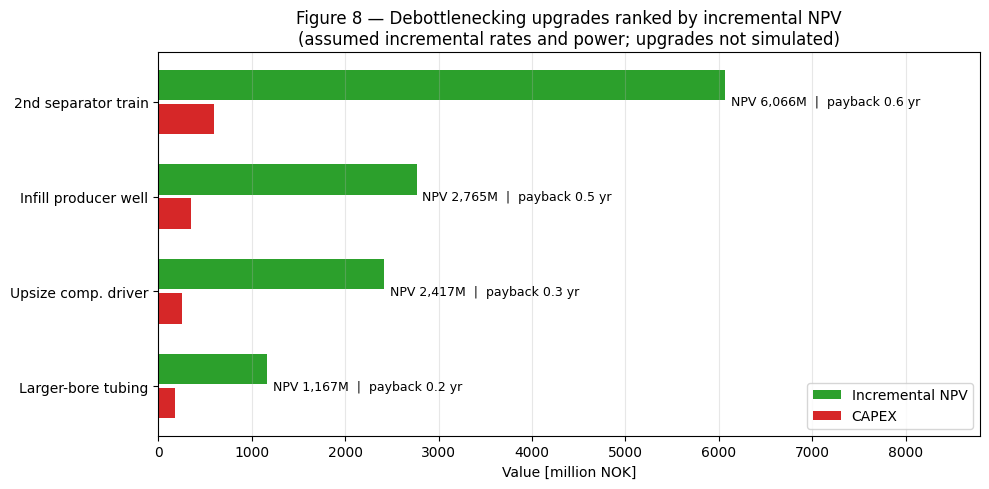
Interpretation of the economics figures
Figure 7 separates gross revenue, net operating value and emissions. Its carbon sensitivity holds production and shaft power fixed, so it is a price sensitivity, not a reoptimized operating policy. The selected point remains a power-only screen.
Figure 8 ranks the supplied hypothetical annual net cash flows after discounting
and CAPEX. It demonstrates the DebottleneckingAdvisor API and the distinction
between absolute NPV, benefit/cost ratio and payback. Each assumed added rate must
be tested against the complete reservoir, well, gathering and topsides model before
using this ranking to choose an upgrade. The code does not infer extra recoverable
reserves from a relaxed equipment limit.
8. Results and scope
The executed output tables and eight figures document the specified cases:
- A synthetic reservoir-to-export pressure cascade built from NeqSim equipment.
- An annual, imposed-rate depletion scenario and a separate capacity stress test.
- A coarse power-only rate sweep, followed by an explicit capacity screen.
- A two-well allocation sweep using the plant-wide bottleneck API.
- Operating cash-flow screening and hypothetical debottlenecking cash-flow ranking.
The largest feasible sampled rate is not a proven continuous maximum. The power-only and full-capacity results answer different questions; the economics screen explicitly labels which it uses. Equipment below 100% utilization is not a binding equality constraint, and overload trajectory points are not feasible production forecasts. Prices, drivers, geometry, well limits and upgrade gains remain declared synthetic inputs.